Prefer a downloadable PDF version? View the PDF guide (opens in a new tab).
Improve your marketing effectiveness with 1:1 views of your customers, prospects, and users.
FullContact’s Resolve empowers you to unify all pieces of your fragmented customer, prospect, and user data to an individual. Improve campaign efficiency and messaging to consumers while providing a memorable customer experience. All in real time via API.
Why Fragmentation Happens
Every brand has the same challenges connecting their customer data. People represent themselves differently as they engage with your brand.
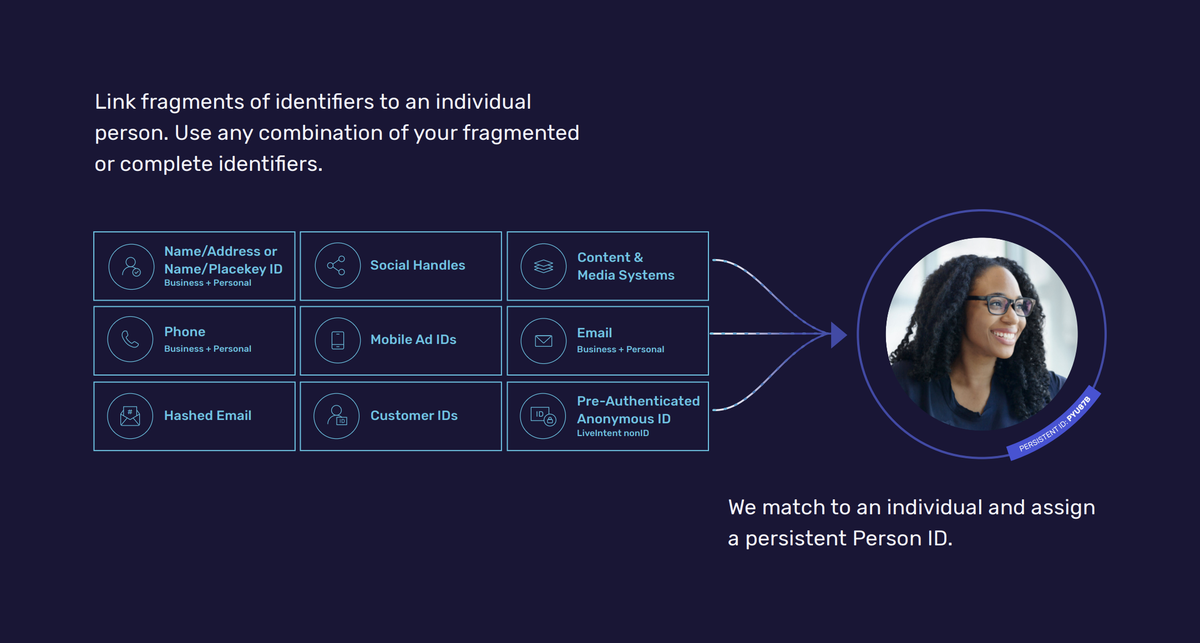
They may call your call center on their business or home phones, make an appointment and provide a street address, follow you on Twitter, download your mobile app and provide their mobile ad ID, or opt in to your loyalty program using their business or personal emails. Resolve links those representations into a whole person, including business and personal identities.
According to Deloitte Digital, companies average 17 customer-data applications, with an average of 28 different data sources used for generating customer insights and engagement.
Consistency Through Persistency
Identify people for consistency in messaging and customer experience, across all channels in real time.
Improve Customer Loyalty
Understand the whole person, even from the fragments of information in siloed data.
Media Optimization
Merge and deduplicate your records, so you can be confident you are not wasting spend or repeating messaging.
FullContact’s Resolve
FullContact’s Resolve empowers you to unify all pieces of your fragmented customer, prospect, and user data to an individual. Improve campaign efficiency and messaging to consumers while providing a memorable customer experience. All in real time via API.
How It Works
Mapping Identities: Using your databases of customer information, fragmented and siloed inputs are mapped to individuals. Each matched record is tied to a persistent identifier at the person level.
Connecting and Optimizing: Use that persistent PersonID to merge or deduplicate your datasets, connect datasets across your enterprise, message consistently, and query FullContact for additional information about that person. Or you can use the PersonID as an anonymous ID in the AdTech and MarTech ecosystem for measurement and optimization.
There Are Endless Uses Cases When Leveraging Resolve
Consistent Customer Experience
If you have fragments of customer information on various platforms, it is highly likely that your messaging is not what you intended. Resolve gives you the ability to communicate with your customers and prospects in a consistent voice, giving them the best possible experience with you.
Unify Customer and Prospect Data
The average business has 17 different data sources for customer insight and engagement. When you have a persistent identifier across your databases, regardless of platform, you can combine customer or prospect records into a complete, whole-person view. This reduces wasteful, duplicate spend on advertising.
Persistent ID for Omnichannel Measurement
Third-party cookies are in decline; the need to measure the effectiveness of marketing messaging and advertising campaigns is not. Your PersonID empowers you to measure online, offline, and cross-device IDs during campaigns to optimize for effectiveness, from exposure to conversion.
Securely Share Your Data Across Platforms
When you have mapped your contacts to a persistent ID, that PersonID is all you need to use across your ecosystem, including AdTech and MarTech platforms. This gives you the power to track customers along their journey without transferring sensitive information.
Privacy Legislation Compliance: CCPA and Beyond
When legally required data requests come in, you can be confident you are sharing the data you have gathered, in a simple, streamlined way. This will give you the ability to respond within legislated timelines and with all the requested information.
Next Steps
If you are interested in learning more about FullContact Resolve, talk with an expert.
Want to keep this guide handy? Download the PDF version (opens in a new tab).