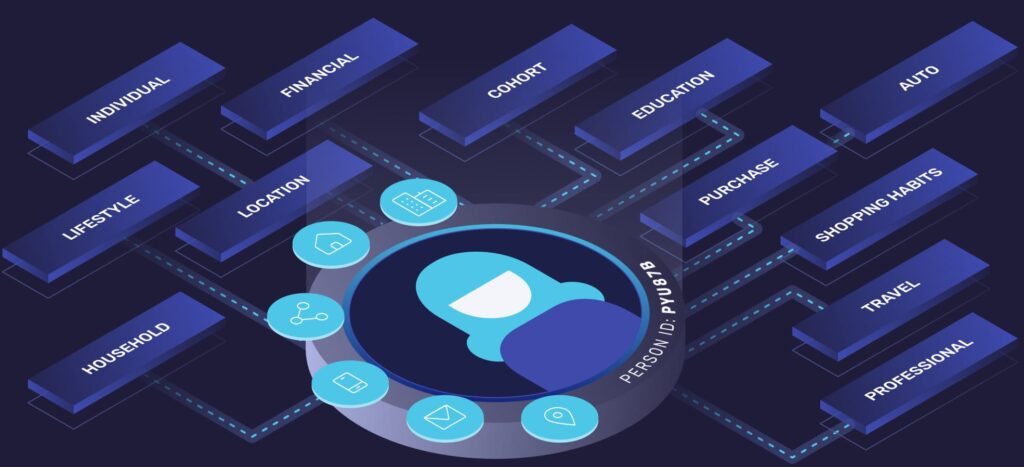
Marketers handle PII responsibly in personalization by collecting only what is necessary, securing it with robust technical safeguards, and operating within a clear legal framework that governs how personal data can be used. Responsible PII management means treating customer data as a trust asset, not just a targeting resource. The questions below unpack what PII actually includes, which laws apply, and how personalization can happen without exposing raw personal data.
What counts as PII in a marketing context?
In a marketing context, PII (personally identifiable information) is any data that can identify a specific individual, either on its own or when combined with other information. This includes obvious identifiers like names, email addresses, and phone numbers, but also extends to less obvious signals such as device IDs, IP addresses, and behavioral data that can be linked back to a real person.
Marketers often work with a broader range of identifiers than they realize. Common examples of PII in marketing data include:
- Direct identifiers: full name, email address, phone number, postal address
- Digital identifiers: IP address, cookie ID, mobile advertising ID, login credentials
- Inferred or derived data: purchase history, browsing behavior, and location signals that, when combined, point to an individual
Understanding the full scope of PII matters because many data points that appear anonymous in isolation become identifiable when linked together. A cookie ID alone may not identify someone, but paired with a known email address, it becomes personal data subject to privacy regulation.
What legal frameworks govern how marketers use PII?
Marketers using PII must comply with a growing set of privacy laws that regulate how personal data is collected, stored, processed, and shared. The most significant frameworks include GDPR in Europe, CCPA and its successor, CPRA, in California, and sector-specific laws like CAN-SPAM and COPPA in the United States. In 2026, additional US state privacy laws continue to expand these obligations nationwide.
These frameworks share several common requirements that shape how marketing teams operate:
- Lawful basis for processing: consent, legitimate interest, or contractual necessity must justify data use
- Data minimization: collect only what is genuinely needed for the stated purpose
- Individual rights: honor requests to access, correct, or delete personal data
- Transparency: disclose clearly what data is collected and how it is used
Non-compliance carries significant financial and reputational risk. Beyond fines, brands that mishandle PII erode the consumer trust that makes personalization effective in the first place. Legal compliance and good data ethics are not in tension; they reinforce each other.
How can marketers personalize without exposing raw PII?
Marketers can deliver personalized experiences without handling raw PII by working with privacy-preserving techniques such as pseudonymization, tokenization, and identity resolution that operates on hashed or anonymized identifiers rather than plain personal data. The goal is to recognize individuals at a meaningful level without exposing the underlying sensitive information to every system or vendor in the stack.
Practical approaches include using hashed emails instead of plain-text addresses for audience matching, building segments based on behavioral signals rather than explicit personal attributes, and applying data clean room environments where two parties can collaborate on data without either side seeing the other’s raw records. These methods allow relevance and personalization to coexist with privacy by design.
How FullContact helps with PII management in personalization
We built our Resolve platform specifically to help marketers personalize at scale without compromising on privacy. Rather than requiring access to raw PII across every touchpoint, we work with hashed identifiers and our own identity graph to connect fragmented signals into a unified customer view. This means your team can recognize returning customers, enrich profiles with relevant insights, and deliver consistent experiences across channels while keeping sensitive personal data protected. Concretely, we help by:
- Resolving identities in real time using hashed or tokenized identifiers, not exposed PII
- Appending 900+ personal and professional insights to customer records without sharing your raw data
- Delivering API responses in under 150 milliseconds so personalization happens at the moment it matters
- Supporting compliance-conscious workflows built around privacy-safe identity resolution from the ground up
If you want to explore how responsible PII management can actually improve your personalization results rather than limit them, feel free to contact us and we will walk you through how it works in practice.