PII management is important for enterprises because it protects sensitive personal data from misuse, breaches, and regulatory penalties. Enterprises collect vast amounts of personally identifiable information across dozens of systems and touchpoints, making structured governance essential rather than optional. Below, we unpack what qualifies as PII in enterprise contexts, what can go wrong without proper management, and how identity resolution fits into the picture.
What types of data count as PII in an enterprise environment?
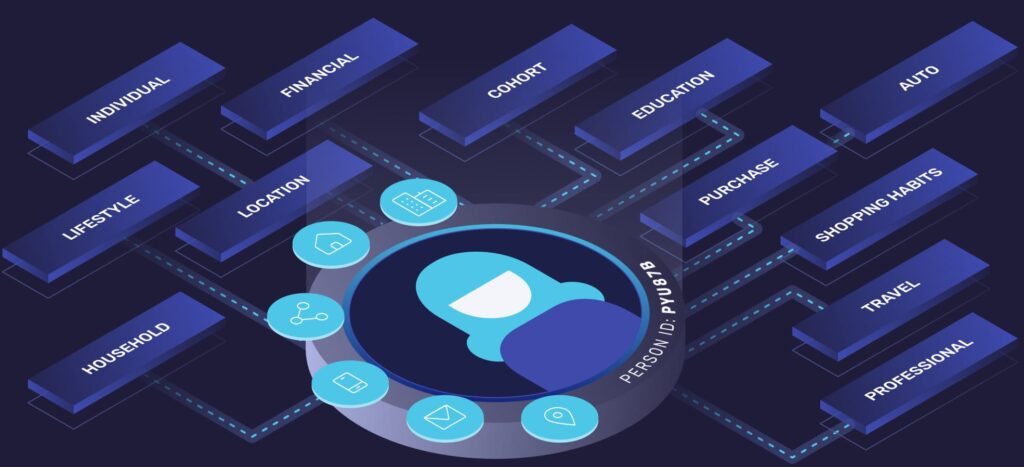
PII, or personally identifiable information, refers to any data that can be used to identify a specific individual, either on its own or when combined with other information. In an enterprise environment, this definition is broader than most teams expect and spans both direct and indirect identifiers.
Direct identifiers are the most obvious examples:
- Full names, email addresses, and phone numbers
- Government-issued IDs, Social Security numbers, and passport details
- Precise location data and IP addresses
- Financial account numbers and payment card details
Beyond these, enterprises must also account for indirect or quasi-identifiers. Job titles, device IDs, cookie data, and behavioral signals can all become PII when combined with other records. This is particularly relevant in enterprise settings, where data flows across CRMs, marketing platforms, data warehouses, and third-party tools simultaneously. The sheer volume and variety of data sources make it easy for sensitive information to exist in places teams are not actively monitoring.
What are the biggest risks of poor PII management for enterprises?
Poor PII management exposes enterprises to regulatory penalties, reputational damage, and loss of customer trust. Regulations such as GDPR, CCPA, and similar frameworks carry significant financial consequences for non-compliance, and enforcement has become more consistent across industries in recent years.
Beyond regulatory risk, fragmented or poorly governed PII creates operational problems. When the same individual exists as multiple disconnected records across systems, teams make decisions based on incomplete or inaccurate profiles. This leads to duplicated outreach, irrelevant personalization, and wasted marketing spend. In fraud prevention contexts, poor data hygiene can also allow bad actors to slip through identity verification processes undetected.
The reputational dimension is equally significant. Customers increasingly expect businesses to handle their data responsibly. A single high-profile data incident can erode years of brand trust, and rebuilding that trust takes far longer than preventing the problem in the first place.
How does PII management connect to identity resolution?
PII management and identity resolution are deeply connected because identity resolution depends on accurately linking PII across systems while keeping that data secure and compliant. Without strong PII governance, identity resolution efforts risk creating profiles that are either inaccurate, incomplete, or built on data that was not properly consented to or stored.
Effective identity resolution requires knowing exactly what PII you hold, where it lives, how it was collected, and what permissions are attached to it. When those foundations are in place, businesses can confidently match identifiers across touchpoints to build unified customer profiles without violating privacy requirements. A well-structured identity graph is central to making this work reliably at scale. When they are not, the matching process itself can introduce compliance risk.
How FullContact helps with PII management
We built our Resolve platform with privacy-safe identity resolution at its core, which means PII management is not an afterthought but a foundational design principle. Here is how we support enterprises in managing PII responsibly while still unlocking the value of their customer data:
- Privacy-by-design architecture: Our platform resolves identities without requiring you to share your raw customer data, keeping sensitive PII within your own environment.
- Real-time identity matching: We link identifiers across devices and touchpoints in under 150 milliseconds, creating unified profiles that reduce duplicate records and data sprawl.
- Consent-aligned enrichment: We append 900+ insights to customer records in a way that respects the consent frameworks your data was collected under.
If your enterprise is working to bring structure and accountability to how it handles personal data, we would love to help you find the right approach. Feel free to contact us to start the conversation.