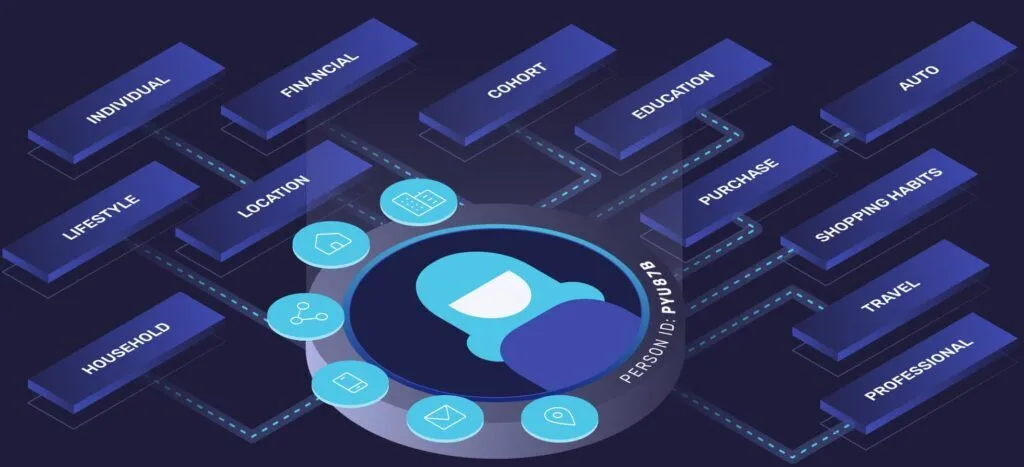
Data enrichment platforms process personally identifiable information by ingesting raw identifiers, such as email addresses, phone numbers, or device IDs, and matching them against a broader identity graph to append additional attributes to a customer record. The platform never needs to expose the underlying PII to produce enriched outputs; instead, it works through hashed, tokenized, or probabilistic matching techniques that keep sensitive data protected throughout the process.
Understanding how this works matters for any business that relies on enriched customer data for personalization, fraud prevention, or audience segmentation. The sections below walk through the types of personally identifiable information involved, how platforms match and protect it, and which privacy regulations shape the entire process.
What types of PII do data enrichment platforms typically handle?
Data enrichment platforms typically handle two broad categories of personally identifiable information: direct identifiers that can pinpoint an individual on their own, and indirect identifiers that become identifying when combined with other data points. Common examples include email addresses, phone numbers, postal addresses, device identifiers, IP addresses, and behavioral signals tied to a specific user session or account.
Direct identifiers are the most sensitive category. An email address alone is enough to link a person across multiple datasets, which is why it is one of the most commonly used inputs in enrichment workflows. Phone numbers carry similar weight. Postal addresses are slightly less precise but still qualify as personally identifiable information under most regulatory frameworks because they narrow identification to a household or individual.
Indirect identifiers require context to become identifying, but they are still treated as PII in responsible enrichment practices. These include:
- IP addresses and device fingerprints tied to browsing sessions
- Cookie IDs and mobile advertising identifiers (MAIDs)
- Behavioral signals such as purchase history or content engagement patterns
- Professional attributes like job title or employer when combined with a name
Beyond raw identifiers, enrichment platforms also append derived attributes to customer records. These can include demographic characteristics, location data, household composition, professional background, and interest-based signals. While these appended attributes are not always PII on their own, they become part of a personally identifiable profile once linked to a specific individual. That linkage is precisely what makes enrichment powerful, and why the handling of these data points demands careful governance.
How does a data enrichment platform match and process PII without exposing it?
A data enrichment platform matches and processes personally identifiable information by using privacy-preserving techniques, primarily hashing, tokenization, and probabilistic graph matching, that allow identity resolution to happen without any party ever seeing the raw PII of another. The input identifier is transformed before it leaves the client’s environment, and matching occurs against similarly transformed records in the identity graph.
Hashing and tokenization as the first line of protection
When a business sends an email address to an enrichment platform, that address is typically hashed using a one-way cryptographic function before transmission. A hashed value cannot be reversed to reveal the original email, but it can be compared against a pre-hashed version of the same address in the platform’s identity graph. If the hashes match, the platform knows the records refer to the same person without either party ever transmitting the plaintext email.
Tokenization works similarly but replaces the identifier with a non-sensitive reference token. The token can be used to retrieve enriched attributes or link records across systems without carrying the PII itself. This approach is particularly useful in advertising and marketing contexts where data passes through multiple intermediaries; each party works with the token, not the underlying personal data.
Graph matching and probabilistic resolution
Not every enrichment workflow starts with a clean, deterministic match. When a business has only a partial identifier, an anonymous device ID, a first-party cookie, or an IP address, the platform uses probabilistic matching to connect that signal to a known identity node in the graph. This involves comparing patterns of co-occurrence: which identifiers have been seen together across authenticated and unauthenticated sessions, and how confidently they can be linked to a single real individual.
The identity graph itself is the underlying structure that makes this possible. Rather than storing isolated records, a well-built Identity Graph connects all known identifiers for a person into a single node, weighted by confidence. When an incoming identifier is matched against the graph, the platform retrieves the enriched attributes associated with that node and returns them to the requesting business, without exposing the other identifiers that helped establish the match.
The result is that enrichment can happen in real time, often in under 200 milliseconds, while the personally identifiable information that powers the match stays protected throughout the entire transaction. The business receives richer customer data; the platform retains no new PII from the business; and the individual’s underlying identity is never transmitted in plaintext across the exchange.
What privacy regulations govern how enrichment platforms handle PII?
Data enrichment platforms that process personally identifiable information are governed by a layered set of privacy regulations that vary by geography and sector. The most influential frameworks include the General Data Protection Regulation (GDPR) in Europe, the California Consumer Privacy Act (CCPA) and its amendment, the CPRA, in the United States, and a growing body of state-level privacy laws that follow similar principles. Each framework imposes specific requirements on how PII can be collected, processed, shared, and deleted.
GDPR and the lawful basis requirement
Under GDPR, any processing of personal data, including enrichment, must rest on a lawful basis. For most commercial enrichment use cases, the relevant bases are legitimate interest or consent. Legitimate interest requires a documented balancing test showing that the business’s purpose does not override the individual’s privacy rights. Consent requires a clear, affirmative opt-in that is specific to the enrichment activity, not buried in a general terms of service agreement.
GDPR also grants individuals the right to access, correct, and erase their personal data. Enrichment platforms operating under GDPR must be able to honor deletion requests that cascade across all records linked to an individual, which is technically demanding when an identity graph connects dozens of identifiers to a single person. Platforms that cannot demonstrate this capability expose their clients to significant regulatory risk.
CCPA, CPRA, and the US state law landscape
In the United States, the CCPA gave California residents the right to know what personal information businesses collect about them, the right to opt out of the sale of that information, and the right to request deletion. The CPRA strengthened these protections by introducing the concept of “sensitive personal information”, a subset of PII that includes precise geolocation, racial or ethnic origin, and financial data, and by establishing the California Privacy Protection Agency as an independent enforcement body.
Beyond California, a growing number of US states have enacted or are enacting comparable frameworks. Virginia, Colorado, Connecticut, Texas, and others have passed comprehensive privacy laws that share core principles around consumer rights, data minimization, and purpose limitation. For enrichment platforms serving US clients, this means compliance is no longer a single-state concern; it requires a consistent, scalable privacy architecture that can respond to consumer rights requests regardless of the state the individual resides in.
Sector-specific regulations add further complexity. Healthcare data enrichment must account for HIPAA. Financial services enrichment intersects with the Gramm-Leach-Bliley Act. Children’s data is governed by COPPA. Enrichment platforms serving clients across multiple industries must understand where these overlapping frameworks apply and build their data handling practices accordingly.
Across all of these regulatory environments, the common thread is accountability: businesses are responsible for what happens to personally identifiable information in their enrichment workflows, even when a third-party platform is doing the processing. Choosing an enrichment partner that has invested in privacy-safe infrastructure, documented data governance, and transparent data sourcing is not just a technical decision; it is a legal and reputational one.
How FullContact helps you process PII safely and effectively
We built our platform specifically to address the tension between enrichment power and privacy responsibility. Here is how we approach it in practice:
- Privacy-safe identity resolution: We use hashing and tokenization so that personally identifiable information is never exposed during the matching process; your data stays yours, and we never retain it.
- Real-time API responses: Our platform returns enriched attributes in under 150 milliseconds, appending 900+ personal and professional insights to new and existing customer records without slowing down your workflows.
- Authentic identity graph: A decade of graph-building means we connect online and offline identifiers around real individuals, not probabilistic clusters, giving you confident, high-fidelity matches across authenticated and anonymous signals.
- Regulatory alignment: Our infrastructure is designed with GDPR, CCPA, and emerging US state privacy laws in mind, so you can enrich customer data without taking on unnecessary compliance risk.
If you want to understand exactly how our approach to personally identifiable information handling fits your specific use case and compliance environment, we would love to walk you through it: contact us and let’s start the conversation.
Related Articles
- What is the difference between an identity graph and identity resolution?
- What is the role of consent management in PII compliance?
- Can you improve audience targeting with customer data enrichment?
- How long does B2B lead identification implementation take?
- How do you identify qualified leads with software?