Businesses can legally use personally identifiable information (PII) by grounding every data practice in a lawful basis, such as consent, legitimate interest, or contractual necessity, and by implementing transparent data governance that aligns with applicable privacy regulations. The key is not avoiding PII altogether, but handling it responsibly: collecting only what you need, securing what you hold, and giving individuals meaningful control over their data. The sections below walk through the most important questions businesses ask about PII compliance, from definitions and legal frameworks to tools and best practices.
What counts as PII under major privacy laws?
Personally identifiable information (PII) is any data that can be used, alone or in combination with other information, to identify a specific individual. Under major privacy laws, PII includes obvious identifiers like full names, email addresses, phone numbers, and government-issued ID numbers, but also extends to less obvious data points such as IP addresses, device identifiers, location data, and even behavioral patterns when they can reasonably be linked to a person.
Different regulatory frameworks define PII with varying degrees of breadth. The EU’s General Data Protection Regulation (GDPR) uses the term “personal data” and takes an expansive view: if information relates to an identifiable natural person, it qualifies. The California Consumer Privacy Act (CCPA) defines personal information similarly broadly, covering household-level data alongside individual-level data. In the United States, sector-specific laws like HIPAA (health data) and FERPA (education records) define protected information within their own domains.
Some categories of PII receive heightened protection under nearly every major law. These typically include:
- Health and medical information
- Biometric data such as fingerprints or facial recognition data
- Financial account details and payment card information
- Racial or ethnic origin, religious beliefs, and sexual orientation
Understanding exactly which data points qualify as PII in each jurisdiction your business operates in is the essential first step before any data strategy can be built responsibly.
What is the difference between PII and non-PII data?
The core distinction between PII and non-PII data is whether the information can be traced back to a specific individual. PII directly identifies or can reasonably be linked to a person: a name, an email address, a Social Security number. Non-PII, by contrast, is data that cannot identify an individual on its own, such as aggregated statistics, anonymized datasets, or general behavioral trends with no individual-level attribution.
The boundary between the two is less fixed than it might appear. Data that seems anonymous in isolation can become personally identifiable when combined with other data points. A zip code on its own is non-PII. Pair it with a date of birth and a gender, and research has shown that combination can uniquely identify a large proportion of individuals. This is the concept of re-identification risk, and it is why regulators increasingly scrutinize so-called “anonymized” datasets.
Pseudonymous data sits in a middle ground. Data that has been pseudonymized (where direct identifiers are replaced with tokens or codes) is still considered personal data under GDPR if re-identification is possible with additional information held by the same organization. True anonymization, which makes re-identification technically infeasible, is the threshold required to move data out of the regulatory scope of most privacy laws.
For practical purposes, businesses should treat any data that could plausibly be linked to an individual as PII and apply appropriate protections, rather than assuming that removing a name from a record makes it safe from a compliance standpoint.
How can businesses legally collect and use PII?
Businesses can legally collect and use PII by establishing a clear lawful basis for each processing activity, being transparent with individuals about how their data is used, and implementing governance practices that keep data use within the boundaries individuals have consented to or that the law otherwise permits. There is no single universal rulebook, but the core principles are consistent across major frameworks.
Establish a lawful basis before collecting data
Under GDPR, every processing activity must rest on one of six lawful bases: consent, contract, legal obligation, vital interests, public task, or legitimate interests. The CCPA does not require a lawful basis in the same way but mandates that businesses disclose their data practices and honor opt-out rights. Whichever framework applies, the principle is the same: you must have a valid reason to collect and process personal data before you do so, not after.
Consent is the most commonly referenced basis, but it is also the most demanding. Valid consent under GDPR must be freely given, specific, informed, and unambiguous. Pre-ticked boxes or bundled consent do not qualify. Legitimate interests can be a more flexible basis, but they require a balancing test demonstrating that the business interest does not override the individual’s rights.
Apply data minimization and purpose limitation
Two principles that appear across virtually every major privacy law are data minimization and purpose limitation. Data minimization means collecting only the personal information you actually need for a defined purpose. Purpose limitation means using that data only for the reason it was collected, not repurposing it later without a fresh legal basis or renewed consent.
In practice, this means building data collection forms and systems around a “need to know” logic rather than a “nice to have” approach. It also means documenting what data you hold, why you hold it, and how long you intend to keep it, a process often formalized in a data inventory or records of processing activities (ROPA).
How does identity resolution help businesses use PII responsibly?
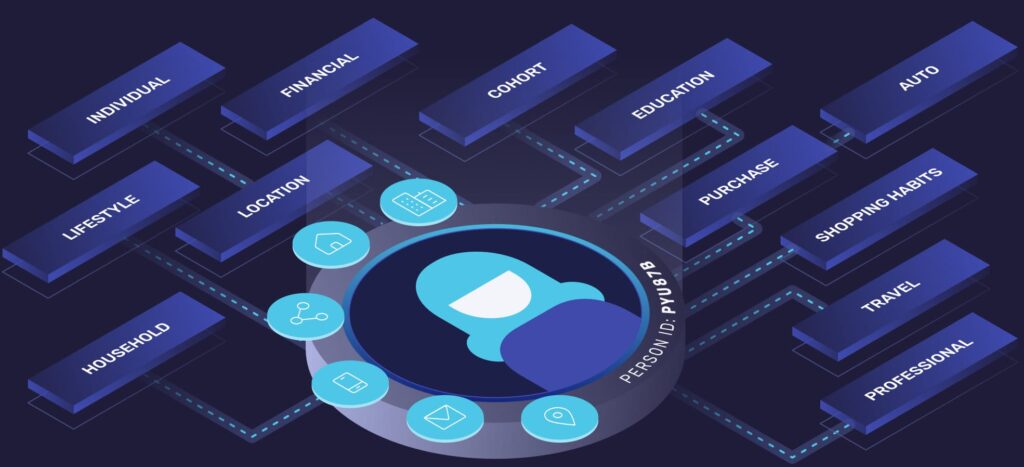
Identity resolution helps businesses use PII responsibly by creating a unified, accurate picture of each customer from fragmented data points, reducing the need to collect redundant or excessive personal information. When a business can reliably link interactions across channels to a single individual, it can deliver personalized experiences and make informed decisions without holding more data than necessary, which directly supports data minimization principles.
The challenge most businesses face is that customer data arrives through many different touchpoints: website visits, mobile apps, in-store transactions, email interactions, and more. Without a way to connect these signals, organizations often duplicate records, hold conflicting information, and end up collecting PII multiple times across systems because they cannot confirm they already have it. Identity resolution solves this by matching identifiers (email addresses, device IDs, cookies, phone numbers) to a persistent customer profile.
From a compliance standpoint, a well-maintained identity graph supports privacy by design. When you know exactly who a customer is and what data you hold about them, you can respond accurately to data subject access requests, honor deletion requests, and maintain clean consent records. Fragmented data makes compliance harder; unified identity makes it manageable.
Identity resolution also helps with fraud prevention. By recognizing when a new identifier is associated with a known individual, businesses can detect anomalies, such as the same person appearing with mismatched details across accounts, without needing to collect additional sensitive data to investigate.
What are the penalties for misusing PII?
The penalties for misusing personally identifiable information vary by jurisdiction and the severity of the violation, but they can be substantial. Under GDPR, regulators can issue fines of up to 4% of a company’s global annual turnover or €20 million, whichever is higher, for the most serious infringements. The CCPA allows for civil penalties of up to $7,500 per intentional violation, with a private right of action for consumers in cases involving data breaches.
Financial penalties are only part of the picture. Regulatory investigations themselves carry significant operational costs: legal fees, staff time, mandatory audits, and remediation requirements. Companies found in violation may also be required to change their data practices under binding enforcement orders, which can affect core business operations.
Reputational damage often proves as costly as the fines themselves. High-profile data misuse cases attract media attention and erode consumer trust in ways that are difficult to quantify but very real in their commercial impact. Research consistently shows that consumers are less likely to share data with, or purchase from, organizations they perceive as irresponsible stewards of personal information.
Penalties can also compound across jurisdictions. A multinational business that mishandles PII may face enforcement actions from regulators in multiple countries simultaneously, each applying its own framework and penalty structure. This makes consistent, global data governance not just a legal obligation but a sound business risk management strategy.
What tools and practices reduce PII compliance risk?
The most effective tools and practices for reducing PII compliance risk combine technical safeguards with organizational processes. No single tool eliminates compliance risk on its own; sustainable risk reduction comes from layering the right technology with clear policies, trained staff, and regular review cycles.
On the technical side, key measures include:
- Data encryption at rest and in transit, ensuring that even if data is accessed without authorization, it cannot be read
- Access controls and role-based permissions that limit who within your organization can view or process PII
- Data masking and pseudonymization for development, testing, and analytics environments where full PII is not required
- Automated data retention and deletion workflows that enforce the principle of not holding personal data longer than necessary
Organizationally, the practices that most reliably reduce risk include maintaining a current data inventory, conducting regular privacy impact assessments for new projects, and appointing a clear owner for data governance, whether that is a formal Data Protection Officer as required under GDPR, or a designated privacy lead in smaller organizations. Staff training is equally important: many data breaches and compliance failures originate from human error rather than technical vulnerabilities.
Consent management platforms (CMPs) help businesses capture, store, and honor user consent at scale, providing an auditable record of what each individual agreed to and when. Paired with a robust identity resolution capability, a CMP ensures that consent signals are correctly matched to the right customer profile across all channels.
How FullContact helps businesses handle PII responsibly
We built FullContact specifically to help businesses navigate the tension between rich, personalized customer experiences and the privacy obligations that come with handling personal data. Our platform is designed around privacy-safe identity resolution, meaning we help you recognize and understand your customers without requiring you to collect or expose more PII than necessary.
Here is how we support responsible PII use in practice:
- Real-time identity resolution: We match fragmented identifiers (emails, device IDs, cookies, phone numbers) to unified customer profiles in under 150 milliseconds, reducing the need to hold duplicate or redundant PII across systems
- Data enrichment without data exposure: Our platform appends 900+ personal and professional insights to customer records while keeping your data and ours separate; you never have to hand over your customer data to benefit from our identity graph
- Privacy-by-design architecture: Our approach is built to support compliance with GDPR, CCPA, and other major privacy frameworks, helping you honor data subject rights accurately and efficiently
If your business is working through how to use personally identifiable information effectively while staying on the right side of privacy regulations, we would love to help you think it through. Contact us and let’s talk about what responsible identity resolution could look like for your organization.
Related Articles
- How does a cross-device identity graph improve omnichannel marketing?
- How do you use sales intelligence for account targeting?
- What consent requirements exist for B2B lead identification?
- How does a lead identification software improve sales conversion?
- How does lead identification softwares integrate with CRM systems?