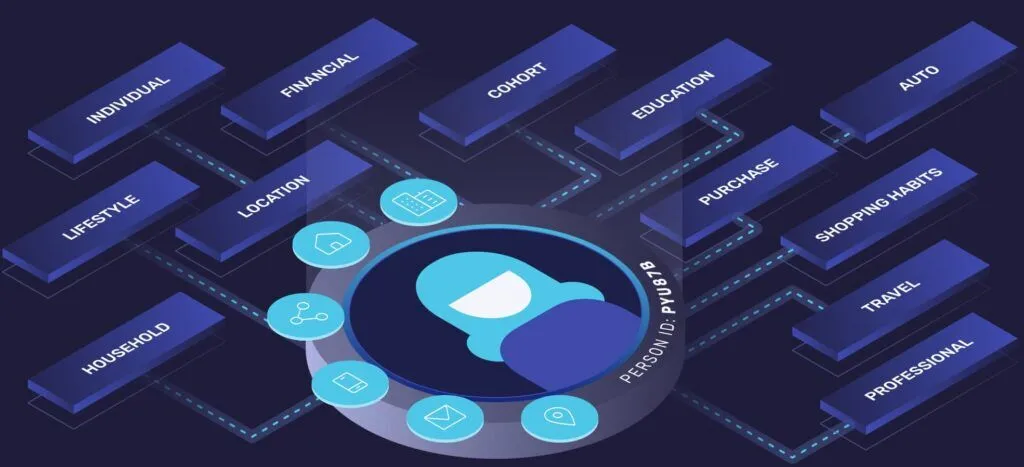
Companies collect personally identifiable information (PII) through every digital and physical touchpoint where a person interacts with a brand, from filling out a form online to making a purchase in-store. This data is then stored in databases, cloud platforms, and customer relationship management (CRM) systems, governed by a growing body of privacy regulations designed to protect individuals. Below, we unpack exactly what qualifies as PII, how it gets collected, and where it ends up.
What types of data count as personally identifiable information?
Personally identifiable information is any data that can be used, on its own or in combination with other data, to identify a specific individual. This includes obvious identifiers like a person’s full name, email address, phone number, or Social Security number, as well as less obvious ones like IP addresses, device IDs, location data, and even behavioral patterns that can be traced back to a unique person.
Privacy frameworks typically divide PII into two broad categories:
- Direct identifiers: data that identifies someone without any additional information, such as a passport number, driver’s license number, or full legal name combined with a date of birth.
- Indirect identifiers: data points that, when combined, can single out an individual, such as a zip code, employer, and job title used together.
What makes the definition of PII nuanced is that context matters enormously. A first name alone is rarely PII. But a first name paired with a home address, workplace, and browsing history almost certainly is. Regulators in different regions draw the line in slightly different places. The European Union’s General Data Protection Regulation (GDPR), for example, takes a broad view and includes pseudonymous data as potentially identifiable. The California Consumer Privacy Act (CCPA) similarly casts a wide net, covering inferences drawn from personal data as well as the raw data itself.
Sensitive categories of PII attract even stricter protections. Health records, biometric data, financial account details, racial or ethnic origin, religious beliefs, and sexual orientation are all treated as higher-risk categories under most major privacy laws, requiring explicit consent and stronger safeguards before they can be collected or processed.
How do companies collect personally identifiable information?
Companies collect personally identifiable information through a wide range of methods, both active and passive. Active collection happens when a person knowingly provides their information, filling out a registration form, subscribing to a newsletter, or completing a purchase. Passive collection happens in the background, often without the individual actively thinking about it, through cookies, tracking pixels, app permissions, and device fingerprinting.
Active collection methods
When users voluntarily share their details, companies gather PII through channels like account sign-ups, contact forms, loyalty program enrollments, surveys, and customer support interactions. Every time someone enters their name, email, phone number, or shipping address into a brand’s interface, that data is captured and associated with their profile. Even actions like saving a wishlist or abandoning a shopping cart can trigger data capture tied to an authenticated identity.
Passive and automated collection methods
Passive data collection is far more pervasive and operates largely behind the scenes. When someone visits a website, cookies placed in their browser can track which pages they visit, how long they stay, and what they click. Mobile apps frequently request access to location services, contacts, and device identifiers. Advertising networks use tracking pixels embedded in emails or web pages to log opens and interactions. Over time, these data points accumulate into detailed behavioral profiles that, when linked to a known identity, become rich sources of personally identifiable information.
Third-party data brokers and data enrichment providers add another layer. Companies often purchase or license data from external sources to fill in gaps in their own records, appending demographic details, professional information, or household data to existing customer profiles. This practice is common in marketing and sales, though it comes with its own set of compliance obligations depending on how the third-party data was originally collected and whether consent was obtained.
Where and how is personally identifiable information stored?
Personally identifiable information is stored across a variety of systems, including CRM platforms, cloud databases, data warehouses, and identity graphs. The specific infrastructure a company uses depends on its size, technical maturity, and the volume of customer data it manages. Regardless of the system, how that data is organized, protected, and accessed is what determines whether it remains secure and compliant.
Most modern enterprises distribute PII across multiple storage environments rather than keeping it in a single location. A customer’s email address might live in a marketing automation platform, their purchase history in an e-commerce database, their support tickets in a helpdesk tool, and their browsing behavior in an analytics system. This fragmentation is one of the central challenges of customer data management, and it is precisely why identity resolution has become so important for businesses trying to build a coherent, unified view of each person they serve.
Key principles that govern how PII should be stored include:
- Encryption at rest and in transit: data should be encrypted both when stored and when moving between systems, preventing unauthorized access if a breach occurs.
- Access controls: only authorized personnel and systems should be able to read or modify personal data, with role-based permissions limiting exposure.
- Data minimization: companies should store only the PII they genuinely need for a stated purpose, reducing risk by limiting what is held.
- Retention policies: personal data should not be kept indefinitely; clear schedules for deletion or anonymization help organizations stay compliant with regulations like GDPR and CCPA.
Cloud infrastructure has become the dominant storage environment for PII, with major providers offering built-in compliance certifications and security tooling. However, the responsibility for configuring those systems correctly still sits with the company collecting the data. Misconfigured cloud storage buckets, for instance, have been a recurring source of large-scale data exposures in recent years, a reminder that the technology itself is only as safe as the people and processes managing it.
Beyond security, data governance frameworks dictate how PII flows through an organization: who can access it, how it can be used, and how long it is retained. Companies operating across multiple jurisdictions often face overlapping regulatory requirements, making governance particularly complex. A customer record that is legal to hold in one country may need to be deleted or modified to comply with laws in another.
How FullContact helps manage personally identifiable information responsibly
We built our platform specifically to help businesses work with personally identifiable information in a way that is both powerful and privacy-safe. Rather than simply storing raw PII in yet another silo, we resolve fragmented identifiers, email addresses, device IDs, cookies, phone numbers, into a single, unified customer profile through our Identity Graph. This means organizations can recognize the same person across channels and touchpoints without duplicating or exposing sensitive data unnecessarily.
Here is what that looks like in practice:
- Real-time identity resolution: our API returns matches in under 150 milliseconds, so customer-facing systems can act on identity data in the moment, not after the fact.
- Privacy-safe architecture: we operate on a model that does not require companies to share their raw customer data with us to benefit from our identity graph, keeping PII within the organization’s own environment.
- Data enrichment: we append 900+ personal and professional insights to customer records, helping businesses fill in the gaps left by fragmented collection without starting from scratch.
If your organization is working through the challenge of collecting, unifying, or enriching customer data while staying on the right side of privacy regulations, we would love to talk through how we can help. Feel free to contact us and let us know what you are trying to solve.