An identity graph enriches existing customer records by appending additional data points to known identifiers, such as an email address or phone number, to build a more complete and accurate picture of each individual. This works by linking multiple signals from online and offline sources into a unified customer profile. The sections below unpack exactly what gets appended, how fragmented identifiers get connected, and why real-time enrichment outperforms traditional batch methods.
What data does an identity graph actually append to a customer record?
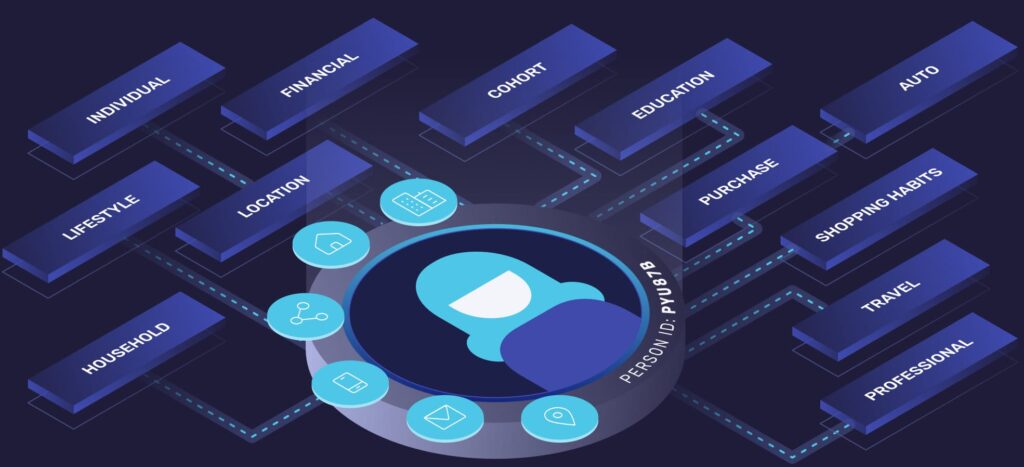
An identity graph appends both personal and professional data points to an existing customer record, transforming a sparse entry into a rich, multi-dimensional profile. These appended attributes typically span demographic details, location signals, professional context, and behavioral indicators, all anchored to a verified individual rather than a device or a cookie.
In practical terms, the enrichment process layers new attributes onto whatever identifiers already exist in a customer record. If a brand holds only an email address, the identity graph uses that email as a starting point and resolves it to a real person, then attaches additional insights drawn from the graph’s underlying data. The result is a record that supports far more targeted and personalized engagement than the original sparse entry ever could.
The categories of data that typically get appended include:
- Demographic attributes such as age range, household composition, and location
- Professional details including job title, employer, and industry
- Interest and lifestyle signals derived from behavioral and affinity data
- Device and channel identifiers that connect the same person across mobile, desktop, and offline touchpoints
The depth of enrichment depends on the breadth of the identity graph itself. A graph built over many years and across diverse data sources will resolve a higher proportion of incoming identifiers and return more attributes per record than a narrower dataset. This is why the quality of the underlying graph matters as much as the enrichment mechanism itself. Businesses that invest in identity graph enrichment gain the ability to communicate with customers as full human beings rather than anonymous data points, which directly improves the relevance of every downstream interaction.
How does an identity graph connect fragmented customer identifiers?
An identity graph connects fragmented customer identifiers by building persistent links between different signals that belong to the same real person. Rather than treating an email address, a phone number, a mobile device ID, and a postal address as separate records, the graph resolves them into a single unified profile through a process called identity resolution.
Fragmentation is one of the most common challenges in modern customer data. A single customer might interact with a brand through a website on their laptop, a mobile app on their phone, a physical store visit, and an email campaign, each generating a different identifier with no obvious connection between them. Without a mechanism to link these signals, a business sees four separate entities instead of one person.
Deterministic matching
Deterministic matching connects identifiers based on exact, verified data points. When a customer provides the same email address at two different touchpoints, the identity graph recognizes the match with high confidence and links those records directly. This approach is highly accurate because it relies on confirmed shared values rather than inference.
Probabilistic matching
Probabilistic matching uses statistical inference to connect identifiers that cannot be linked deterministically. When two records share overlapping signals, such as the same device type, location pattern, and browsing behavior, the graph assigns a probability score to the likelihood that they belong to the same individual. This extends coverage to situations where exact matches are not available, trading some precision for greater reach.
The most effective identity graphs combine both methods. Deterministic links anchor the profile with high-confidence connections, while probabilistic signals extend the graph’s reach to cover anonymous or partial interactions. Over time, as more interactions are observed and more identifiers are confirmed, the graph strengthens its connections and the resulting customer profiles become progressively more accurate and complete.
This unified view is what makes enrichment meaningful. Appending data to a fragmented record produces fragmented insights. Appending data to a resolved, unified profile produces a coherent understanding of the customer that can actually inform personalization, segmentation, and targeting decisions.
How does real-time enrichment differ from batch data appending?
Real-time enrichment resolves and appends identity data to a customer record at the moment of interaction, typically within milliseconds, whereas batch data appending processes records in bulk at scheduled intervals, often hours or days after the interaction occurred. The core difference is timing, and timing determines whether enriched data can influence the experience that is actually happening.
Batch appending has been the traditional approach to data enrichment. A business exports a file of customer records, sends it to a data provider, receives an enriched file back, and imports it into their systems. This works well for retrospective analysis, audience segmentation built in advance, or periodic data hygiene tasks. The limitation is that the enriched data is always a snapshot of the past, and by the time it is applied, the customer’s context may have changed.
Real-time enrichment operates on a fundamentally different model. When a customer lands on a website, submits a form, or triggers any interaction, the enrichment call fires instantly via API. The system resolves the incoming identifier against the identity graph and returns appended attributes before the interaction is complete. This means the personalization, the offer, or the routing decision can be shaped by up-to-date identity insights rather than stale batch data.
The practical implications of this difference are significant:
- Personalization accuracy improves when enrichment reflects the customer’s current context rather than their profile from a previous batch cycle
- Fraud prevention becomes more effective because real-time signals can flag anomalies at the point of transaction rather than after the fact
- Onboarding flows can be tailored immediately based on who a person is, reducing friction and improving conversion
- Ad targeting and suppression stay current, so campaigns reach the right people without wasting spend on audiences that have already converted or churned
For use cases where timing is not critical, such as building lookalike audiences or refreshing a CRM on a weekly basis, batch appending remains a practical and cost-effective option. But for any use case where the customer experience needs to respond to who a person is in the moment, real-time enrichment through an identity graph API is the only approach that delivers on that promise.
How FullContact helps enrich your customer records with an identity graph
We built our Resolve platform specifically to address the enrichment and identity resolution challenges described throughout this article. Our identity graph has been developed over more than a decade, connecting online and offline data around real individuals rather than devices or probabilistic proxies. When a customer identifier enters our system, we resolve it in real time and return enriched attributes in under 150 milliseconds, making genuine real-time personalization achievable at scale. Here is what that looks like in practice:
- Append 900+ personal and professional insights to new and existing customer records
- Resolve authenticated and anonymous identifiers into a single unified customer profile
- Access the full depth of our identity graph through a privacy-safe API without sharing your own customer data
- Support use cases from personalization and segmentation to fraud prevention and omnichannel marketing optimization
Whether you are working to unify fragmented customer data, improve the accuracy of your existing records, or build richer audience segments, we are here to help you get there. Contact us to talk through your specific enrichment needs and explore how our identity graph can work for your business.