First-party personally identifiable information (PII) and third-party data differ in their origin, accuracy, and legal standing. First-party PII is data your customers share directly with you (names, email addresses, phone numbers, purchase history), while third-party data is collected by external parties and sold or licensed to marketers without a direct relationship to the individual. For marketers, that distinction has become one of the most consequential in the industry.
First-party PII carries consent signals, tends to be more accurate, and reflects genuine intent because the person chose to share it with your brand. Third-party data, by contrast, is often aggregated, inferred, or modeled: useful for scale, but increasingly restricted by privacy regulations and platform policy changes. The sections below unpack the key questions marketers are asking about these two data types in 2026.
What makes first-party PII more valuable than third-party data?
First-party PII is more valuable than third-party data because it is accurate, collected with consent, and directly tied to real customer behavior with your brand. When someone provides their email address, phone number, or home address to your business, that information reflects a genuine relationship, not a probabilistic inference made by a data broker who has never interacted with that person.
The value gap between the two data types has widened significantly as the advertising ecosystem evolves. Third-party cookies are being phased out across major browsers, signal loss is compounding across mobile platforms, and regulators in the US, EU, and beyond are tightening the rules around how data collected without a direct relationship can be used. First-party personally identifiable information sits outside most of those pressures because the consent framework is cleaner and the data source is transparent.
There are several concrete reasons why first-party PII outperforms third-party data in marketing contexts:
- Accuracy: Data collected directly from a customer is far less likely to be stale, misattributed, or modeled from behavioral proxies.
- Consent clarity: The customer knowingly shared their information, making compliance with privacy regulations more straightforward.
- Relevance: First-party data reflects actual interactions with your brand (purchases, browsing, preferences) rather than generic demographic inferences.
- Durability: Unlike third-party data that can be deprecated overnight by platform policy changes, first-party PII remains available as long as you maintain the customer relationship.
Third-party data still has a role to play, particularly for prospecting and audience expansion where you have limited first-party coverage. But as a foundation for personalization, identity resolution, and long-term customer strategy, personally identifiable information collected directly from your audience is the stronger asset by a significant margin.
How can first-party PII be used to resolve customer identity?
First-party PII can be used to resolve customer identity by serving as anchor identifiers that link fragmented signals (across devices, sessions, and channels) back to a single, verified individual. When a customer provides an email address or phone number at any touchpoint, that piece of personally identifiable information becomes a persistent key that can connect their anonymous browsing behavior, authenticated app activity, and offline purchase history into one unified profile.
Identity resolution is the process of matching and merging these disparate identifiers into a coherent customer record. First-party PII is the most reliable input into that process because it is deterministic: it was provided directly by the person, rather than inferred from behavioral patterns or device signals that may belong to multiple users.
How deterministic matching works with PII
Deterministic identity matching uses exact-match logic on known identifiers. When a customer logs in with their email address on your website, that authenticated signal can be matched against the same email address in your CRM, your email platform, your loyalty database, and any other system where that identifier exists. The result is a single customer view that spans every channel where that person has engaged with your brand.
This is where first-party PII becomes genuinely powerful. A single email address can unlock a chain of connections, linking a mobile device ID from an app install, a shipping address from an e-commerce order, and a loyalty card number from an in-store purchase, all belonging to the same individual. The personally identifiable information acts as the connective tissue between otherwise siloed data sources.
Extending reach with an identity graph
First-party PII does not have to work in isolation. When your customer records are matched against a broader identity graph, the resolution process can extend beyond what your own data alone can see. An identity graph is a large-scale network of linked identifiers (emails, device IDs, IP addresses, physical addresses, and more) that enables businesses to recognize individuals even when only a partial set of identifiers is available.
For example, if a visitor arrives at your website without logging in, you may only have an anonymous device signal. But if that device was previously linked to a known email address within an identity graph, the visitor can be recognized as an existing customer, enabling personalized experiences in real time, without requiring a fresh login event. This is the practical application of combining first-party PII with a robust identity infrastructure.
What privacy risks apply to first-party PII that don’t apply to third-party data?
First-party PII carries a distinct set of privacy risks because your organization is the direct custodian of that data and therefore bears full responsibility for how it is collected, stored, used, and protected. With third-party data, the original data collector and the broker share portions of that liability, but when a customer hands their personally identifiable information directly to your brand, your organization owns the entire compliance obligation.
That responsibility is meaningful. A data breach involving first-party PII (names, email addresses, phone numbers, payment information) exposes real, identifiable individuals and triggers notification requirements under laws like GDPR, CCPA, and a growing number of US state privacy statutes. Third-party data, because it is often aggregated or pseudonymized before it reaches you, may carry a lower direct breach exposure, though that distinction is narrowing as regulations evolve.
Consent and purpose limitation obligations
When you collect first-party PII, you are typically bound by the specific purpose for which the customer shared it. If someone provides their email address to receive order confirmations, using that address for unrelated marketing campaigns may violate the terms under which it was collected, and potentially applicable privacy law. Third-party data often arrives with broad, pre-negotiated use licenses that, while ethically questionable, may give the buyer more operational flexibility in the short term.
This means your first-party data strategy requires careful governance: clear consent language at the point of collection, documented data use policies, and mechanisms that allow customers to access, correct, or delete their information on request. These are obligations that do not typically attach to third-party data purchases in the same direct way.
Data minimization and retention risk
Because first-party PII is tied to real individuals who have an ongoing relationship with your brand, retaining it beyond its useful purpose creates compounding risk. The longer personally identifiable information sits in your systems, the greater the exposure if a breach occurs, and the more complex your compliance posture becomes under regulations that require data minimization and defined retention limits. Third-party data, which is often refreshed or replaced on a rolling basis, does not carry the same long-term retention expectations.
The practical implication is that first-party PII demands active data hygiene: regular audits of what you hold, clear retention schedules, and processes for honoring deletion requests. These are not burdens unique to PII, but they are more acute when the data is directly linked to identifiable individuals who trust your brand with their information.
How FullContact helps with first-party PII and identity resolution
We built our platform specifically to help businesses get more value from their first-party personally identifiable information while staying on the right side of privacy requirements. Rather than replacing your first-party data with third-party alternatives, we extend and enrich it, using our identity graph to resolve fragmented customer signals into unified profiles in real time.
Here is what that looks like in practice:
- Real-time identity resolution: We match your customer identifiers against our identity graph and return a resolved profile in under 150 milliseconds, enabling personalization at the moment of interaction.
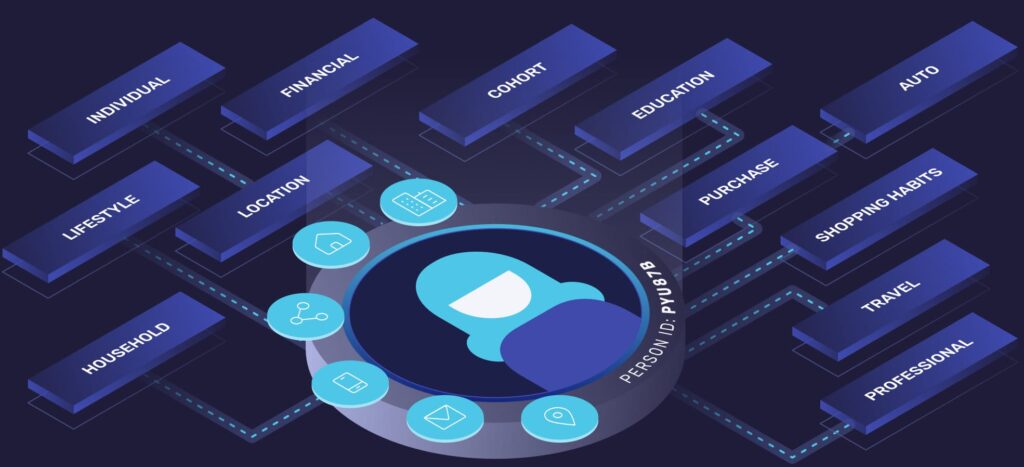
- Data enrichment: We append 900+ personal and professional insights to your existing customer records, giving your team a richer picture of who your customers are without requiring them to share more information.
- Privacy-safe architecture: Our platform is designed so that your first-party data never leaves your control: you gain access to our identity graph without contributing your customer data to it.
If you are working through how to build a more durable, PII-driven identity strategy for your brand, we would love to talk through the specifics of your use case: feel free to contact us, and we can explore what the right approach looks like for your team.
Related Articles
- How does an identity graph improve data enrichment outcomes?
- What role does PII management play in GDPR compliance?
- What data can you append to an existing customer record?
- What is the difference between first-party and third-party data enrichment?
- How does lead identification software reduce sales cycle time?