Businesses should handle personally identifiable information responsibly by collecting only what they genuinely need, securing it with appropriate technical and organizational safeguards, being transparent with individuals about how it is used, and complying with applicable data protection laws. Responsible PII handling is not just a legal obligation. It is a foundation of customer trust, and mishandling it carries real financial, reputational, and regulatory consequences for any organization.
The specific steps a business must take depend on where it operates, the type of personally identifiable information it collects, and the purposes for which it processes that data. The sections below break down what PII actually includes, which legal frameworks apply, and how to collect it in a way that protects both your customers and your business.
What counts as personally identifiable information?
Personally identifiable information, commonly abbreviated as PII, is any data that can be used on its own or in combination with other information to identify, contact, or locate a specific individual. This includes obvious identifiers like a person’s full name, home address, email address, phone number, or government-issued ID number, as well as less obvious data points that can still single someone out when combined.
Direct identifiers
Direct identifiers are data points that identify a person without needing any additional information. These are the clearest examples of personally identifiable information and the ones most people immediately recognize:
- Full legal name
- Social Security number or national ID number
- Passport or driver’s license number
- Biometric data such as fingerprints or facial recognition profiles
Because direct identifiers leave no ambiguity about who they belong to, they attract the highest level of scrutiny under most data protection frameworks and require the strongest safeguards.
Indirect and quasi-identifiers
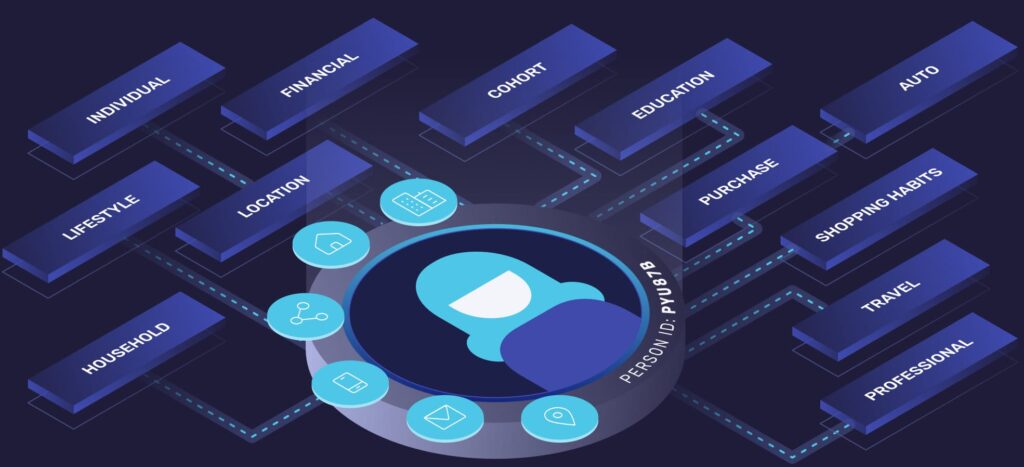
Indirect identifiers are data points that do not identify someone on their own but can do so when combined with other available information. IP addresses, device identifiers, location data, browsing behavior, and demographic details like age, gender, and zip code all fall into this category. A single data point may seem harmless, but two or three together can narrow down a population to a single identifiable person, a phenomenon data professionals refer to as re-identification.
Sensitive categories of PII warrant special attention. Health records, financial account details, racial or ethnic origin, religious beliefs, sexual orientation, and information about minors are treated as higher-risk personal data under most legal frameworks, often requiring explicit consent and additional protective measures before they can be lawfully processed.
What legal frameworks govern how businesses handle PII?
Several major legal frameworks govern how businesses collect, store, use, and share personally identifiable information, and the rules that apply to your organization depend primarily on where your customers are located, not just where your business is based. Operating globally means navigating multiple overlapping regimes simultaneously.
Key regulations by region
The most influential data protection law in the world is the European Union’s General Data Protection Regulation, known as the GDPR. It applies to any organization that processes the personal data of EU residents, regardless of where that organization is headquartered. The GDPR requires a lawful basis for processing, mandates transparency through privacy notices, grants individuals rights over their data, and imposes significant fines for non-compliance.
In the United States, there is no single federal equivalent to the GDPR. Instead, a patchwork of sector-specific and state-level laws governs personally identifiable information. The California Consumer Privacy Act and its amendment, the California Privacy Rights Act, are the most comprehensive state-level frameworks and have influenced similar legislation in other states. Sector-specific laws like HIPAA for health data and GLBA for financial information add further layers of obligation for businesses operating in those industries.
Other significant frameworks include Canada’s PIPEDA, Brazil’s LGPD, and the UK GDPR, which mirrors EU rules but operates independently following Brexit. Businesses with international customers should map their data flows carefully and seek legal guidance on which frameworks apply, since the consequences of non-compliance can include regulatory fines, enforcement actions, and civil liability.
Core principles shared across frameworks
Despite regional differences, most major data protection laws share a common set of principles. Understanding these shared principles helps businesses build a compliance posture that works across jurisdictions rather than addressing each law in isolation:
- Purpose limitation: Collect personally identifiable information only for specific, stated purposes and do not repurpose it without a fresh legal basis.
- Data minimization: Gather only the data you genuinely need, no more.
- Storage limitation: Retain PII only for as long as necessary, then delete or anonymize it.
- Individual rights: Respect people’s rights to access, correct, delete, or restrict the use of their data.
These principles are not just regulatory checkboxes. They represent a coherent philosophy of data stewardship that, when embedded into business operations, reduces risk and builds genuine trust with customers.
How should businesses collect PII responsibly?
Businesses should collect personally identifiable information responsibly by establishing a clear legal basis before collection begins, being transparent with individuals about what is gathered and why, minimizing the data collected to only what is necessary, and securing it from the point of collection onward. Responsible collection is not a one-time action. It is an ongoing practice embedded into every touchpoint where customer data enters your systems.
Establish a lawful basis before you collect
Under most data protection frameworks, you cannot simply collect personally identifiable information because it would be useful. You need a recognized legal basis. Depending on the jurisdiction and the type of data involved, that basis might be explicit consent from the individual, a contractual necessity, a legitimate business interest, or a legal obligation. Identifying the correct basis before collection begins shapes everything that follows: how you communicate with customers, how long you retain data, and what rights individuals can exercise over it.
Consent, when used as the legal basis, must be freely given, specific, informed, and unambiguous. Pre-ticked boxes, buried terms, and vague language do not meet the standard required by most modern privacy laws. If you rely on legitimate interests instead, you should conduct and document a balancing test that weighs your business need against the individual’s reasonable privacy expectations.
Be transparent and communicate clearly
Transparency is one of the most consistently required obligations across data protection frameworks, and it is also one of the most practically important for building customer trust. At the point of collection, individuals should understand what personally identifiable information you are gathering, why you are gathering it, how long you intend to keep it, who you might share it with, and what rights they have over it. This information is typically delivered through a privacy notice or policy, but that document should be written in plain language, not legal boilerplate that no one reads.
Clarity at the point of collection also means not burying consent requests inside lengthy terms and conditions. If you are asking someone to agree to marketing communications, make that ask distinct and specific. If you are collecting data for multiple purposes, address each purpose separately rather than bundling them into a single catch-all statement.
Secure data from the moment it enters your systems
Responsible collection extends to the technical and organizational measures you put in place to protect personally identifiable information once it arrives. Encryption in transit and at rest, access controls that limit who within your organization can view sensitive data, and regular security audits are foundational requirements. Businesses that collect PII without securing it are not just exposing customers to harm. They are creating significant legal and reputational liability for themselves.
Equally important is having a clear data retention policy. Holding personally identifiable information indefinitely is both a security risk and a compliance failure. Define how long each category of data needs to be retained to serve its stated purpose, and build automated processes to delete or anonymize it once that period expires. The less data you hold, the smaller your attack surface and the lower your regulatory exposure.
How FullContact helps businesses handle personally identifiable information responsibly
We built our platform specifically to help businesses work with identity data in a way that is both effective and privacy-safe. Rather than encouraging organizations to accumulate large volumes of raw personally identifiable information, we help them do more with less, resolving fragmented customer identifiers into a unified view without requiring businesses to hold sensitive data they do not need. Our approach centers on a few concrete capabilities:
- Privacy-safe identity resolution: Our Identity Graph connects authenticated and anonymous identifiers to build a single customer profile without exposing raw PII across systems or third parties.
- Real-time enrichment: We append 900+ personal and professional insights to customer records in under 150 milliseconds, reducing the need for businesses to collect excessive data directly from their customers.
- Data minimization by design: Our architecture allows your organization to recognize and understand individuals without giving away your own customer data, keeping your data assets secure while still enabling personalized experiences.
If your business is working through how to handle personally identifiable information responsibly while still delivering the kind of personalized experiences your customers expect, we would love to help. Contact us to talk through how our platform can support your data strategy.
Related Articles
- How does an identity graph support hyper-personalized marketing?
- What is the difference between an identity graph and a relational database?
- How do you identify PII in your customer data?
- Can data enrichment services help reduce incomplete customer records?
- What is the implementation timeline for lead identification software?