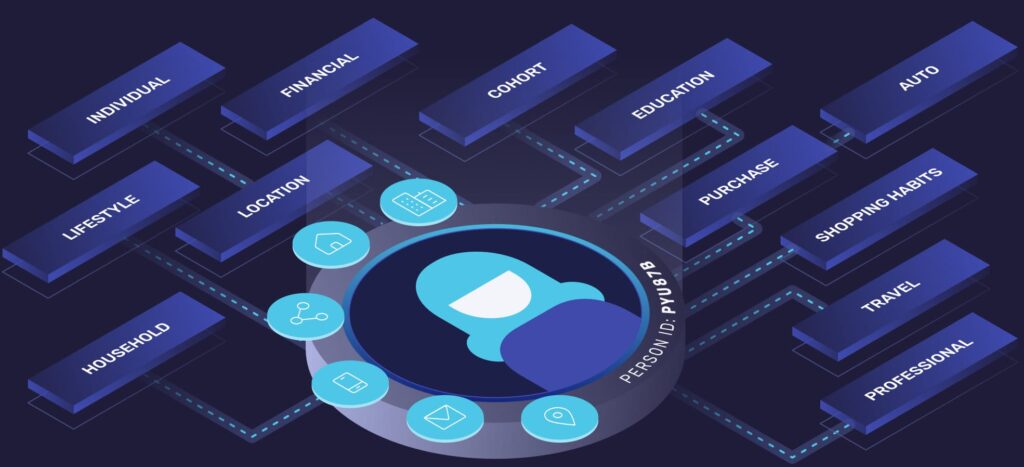
An identity graph benefits brands by creating a unified, persistent view of each customer across every touchpoint and device. Instead of storing fragmented data in disconnected silos, an identity graph links multiple identifiers — email addresses, device IDs, cookies, phone numbers — into a single, coherent customer profile. The sections below unpack how identity graphs work, what business problems they solve, and how they power smarter personalization.
How does an identity graph actually work?
An identity graph works by connecting disparate identifiers associated with a real person into one unified record. Every time a customer interacts with a brand — browsing a website, opening an email, or making an in-store purchase — they leave behind identifiers. The identity graph ingests these signals and uses matching logic to determine which identifiers belong to the same individual, building a persistent profile that evolves in real time.
The matching process typically combines two approaches. Deterministic matching links identifiers using known, confirmed data points like a verified email address. Probabilistic matching uses behavioral signals and statistical inference to connect identifiers when a direct match is not available. Together, these methods allow the graph to bridge authenticated and anonymous interactions, so a brand can recognize a returning visitor even when they have not logged in.
What makes an identity graph different from a standard customer database is its structure. Rather than storing rows of customer records, it maps relationships between identifiers, devices, and individuals. This relational structure means the graph can accommodate new data points without rebuilding the entire dataset from scratch.
What business problems does an identity graph solve?
An identity graph solves the core problem of customer fragmentation — the state where one real person appears as dozens of unrelated records across a brand’s systems. This fragmentation leads to wasted ad spend, poor customer experiences, and unreliable analytics. By resolving those fragments into a single identity, brands gain accuracy and efficiency across their entire operation.
Specific problems an identity graph addresses include:
- Duplicate customer records that inflate databases and distort reporting
- Cross-device attribution gaps that make it impossible to trace a full customer journey
- Audience overlap in paid media that causes the same person to be targeted multiple times
- Fraud risk where unresolved identities make it harder to detect suspicious patterns
Beyond cleaning up data, an identity graph creates a foundation for more strategic decisions. When a brand knows that a mobile app user, an email subscriber, and a loyalty program member are all the same person, it can allocate budget more effectively, suppress already-converted customers from acquisition campaigns, and measure true reach rather than inflated impressions.
How does an identity graph improve personalization?
An identity graph improves personalization by giving brands a complete, accurate picture of each customer rather than a partial one. Personalization fails when it is based on incomplete data — recommending a product someone already bought, or sending a welcome email to a long-time customer. A resolved identity profile eliminates these errors by ensuring every interaction draws on the full history of that individual.
With a unified identity in place, brands can tailor messaging based on a customer’s real behavior across channels, not just their activity within a single touchpoint. A customer who browsed a product on mobile, read a review email, and then converted in-store can be recognized as a single journey rather than three separate events. This continuity allows marketing teams to deliver the right message at the right moment without redundancy or contradiction.
Personalization also extends beyond marketing. Customer service teams can access a complete interaction history, reducing friction during support conversations. Product teams can segment users more accurately for feature rollouts. The identity graph becomes the shared source of truth that makes consistency possible across every function that touches the customer.
How FullContact helps with identity graph marketing
We built our Resolve platform specifically to give brands the kind of identity graph that makes real personalization and accurate measurement possible. Our platform connects authenticated and anonymous identifiers in real time, delivering API responses in under 150 milliseconds so that resolved identity data is available at the moment it matters most. With access to our identity graph, brands can:
- Append 900+ personal and professional insights to new and existing customer records
- Recognize returning visitors across devices without relying solely on third-party cookies
- Unify fragmented customer data without sharing or exposing their own data
- Support fraud prevention through more accurate individual-level identification
Our approach is privacy-safe by design, built on more than a decade of constructing a true identity graph centered on real individuals rather than device signals alone. If you want to explore how identity resolution can work for your brand, contact us and we will walk you through what is possible.
Related Articles
- How do you link multiple identifiers without exposing PII directly?
- What is a real-time identity graph and why does it matter?
- What features matter in lead identification tools?
- What is the difference between lead identification and lead generation software?
- How does lead identification software measure lead quality?