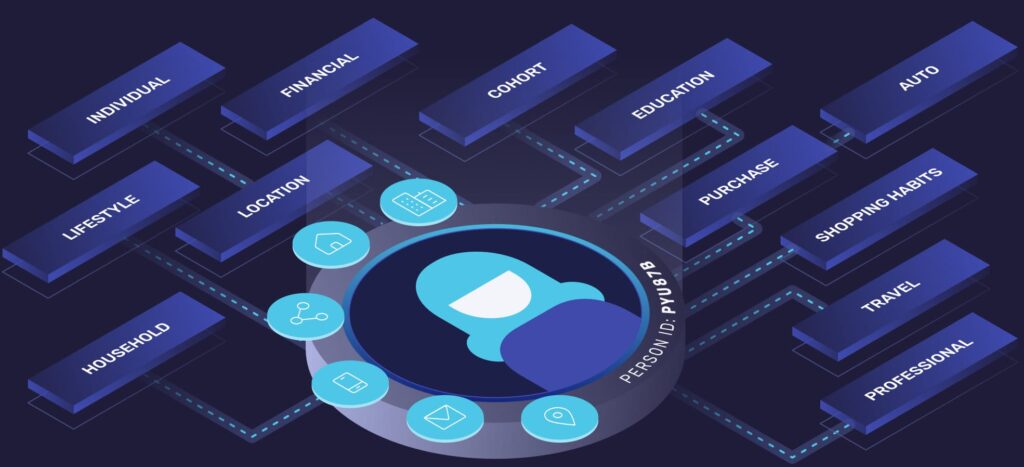
Building your own identity graph comes with significant limitations, primarily around cost, data coverage, and time. For most organizations, the investment required to construct and maintain a reliable identity graph in-house far exceeds what they anticipate, while the resulting graph often still falls short of the breadth and accuracy that purpose-built solutions deliver. The sections below break down the three most common challenges businesses run into when they attempt to go it alone.
Why is building an identity graph so expensive?
Building an identity graph in-house is expensive because it requires sustained investment across infrastructure, data acquisition, engineering talent, and ongoing maintenance, all at once. Unlike a one-time software purchase, an identity graph is a living system that demands continuous resources to remain accurate and useful. The costs compound quickly, and many organizations underestimate the full scope until they are already committed.
The expense breaks down across several interconnected layers. On the infrastructure side, storing and processing the volume of data needed to resolve identities at scale requires significant compute and storage capacity. Identity resolution involves matching billions of signals across devices, channels, and touchpoints in real time, which places heavy demands on data pipelines and query performance.
Data acquisition is another major cost driver. An identity graph is only as strong as the data feeding it. To connect online and offline identifiers reliably, organizations need access to a wide range of data sources: email hashes, device IDs, IP addresses, postal records, and more. Licensing or sourcing this data from third parties carries ongoing fees, and the quality of those sources varies considerably.
Then there is the human cost. Building and maintaining an identity graph requires specialized expertise across data engineering, data science, privacy compliance, and identity resolution methodology. These roles are difficult to hire for and expensive to retain. Privacy regulations such as GDPR and CCPA add another layer of complexity, requiring legal and compliance resources to ensure that data handling meets current standards, and those standards continue to evolve.
Finally, the graph itself requires constant upkeep. People change email addresses, move homes, switch devices, and create new accounts. Without continuous data refreshes and matching logic updates, the graph degrades in accuracy over time, making the maintenance burden as significant as the initial build.
What data coverage gaps do in-house identity graphs have?
In-house identity graphs typically suffer from narrow data coverage because they are built primarily on first-party data, the signals a company collects directly from its own customers. While first-party data is valuable, it only captures a fraction of a person’s full identity footprint, leaving significant gaps in how completely and accurately the graph can resolve individuals across contexts.
The most common coverage gaps include:
- Anonymous visitor blind spots: Most website visitors never authenticate, meaning they leave no first-party identifier behind. Without the ability to link anonymous signals to known profiles, a large share of traffic remains unresolvable.
- Cross-device fragmentation: A single person may use a smartphone, a laptop, and a tablet across the same day. Without external data to bridge those devices, in-house graphs treat them as separate individuals.
- Offline identity gaps: Physical interactions (in-store purchases, direct mail responses, phone inquiries) generate identity signals that rarely make it into digital-first data systems without deliberate offline data integration.
- Data decay: First-party records go stale quickly. Without external data to validate and refresh records, an in-house graph accumulates outdated information that reduces match rates and personalization accuracy.
The root of these gaps is reach. A purpose-built identity graph draws on data relationships built across thousands of sources and billions of interactions over many years. An in-house graph starts from scratch, limited to whatever touchpoints a single organization controls. Even large enterprises with substantial first-party data find that their graph covers only a subset of the individuals they want to reach or recognize.
There is also the question of identity signal diversity. Resolving an individual reliably requires matching across multiple identifier types simultaneously: hashed emails, mobile advertising IDs, IP addresses, and offline identifiers like postal addresses. Most in-house efforts lack the breadth of signal types needed to achieve high match rates, particularly for less-engaged or anonymous segments of their audience.
How long does it take to build a reliable identity graph?
Building a reliable identity graph typically takes years, not months. Most organizations that attempt an in-house build underestimate the timeline significantly. A functional prototype may come together in several months, but a graph that delivers consistent, high-quality identity resolution at scale (with broad coverage and low false-positive rates) generally requires multiple years of data accumulation, model refinement, and operational maturation.
The timeline is shaped by several compounding factors. First, identity graphs improve with data volume. The more signals the graph ingests and the more matches it processes, the better its matching logic becomes at distinguishing true identity connections from coincidental ones. This means the graph gets meaningfully more accurate over time, but only if it is consistently fed quality data from the start.
Second, building trust in the graph’s output takes time. Identity resolution is not just a technical challenge: it is an operational one. Teams need to validate match quality, investigate false positives, tune confidence thresholds, and build internal processes around how resolved identities are used across marketing, analytics, and product systems. That validation cycle alone can stretch across many months.
Third, the regulatory and privacy landscape adds timeline risk. Privacy laws require that identity data be collected, stored, and used in specific ways. If compliance requirements change (as they frequently do), engineering resources must be redirected to update data handling practices rather than improving the graph itself. This kind of interruption is common and difficult to plan around.
By the time a reliable in-house identity graph is operational, the business landscape may have shifted considerably. Competitors who adopted a third-party identity resolution solution years earlier will have already acted on insights that the in-house team is only beginning to unlock. The time-to-value gap is one of the most underappreciated costs of building in-house.
How FullContact helps with identity graph limitations
We built FullContact specifically to address the limitations that make in-house identity graphs so difficult to sustain. Rather than asking businesses to spend years assembling their own graph from scratch, we offer immediate access to a mature, real-time identity graph built over more than a decade, one that connects online and offline identifiers across devices and channels into a single, privacy-safe customer profile.
Here is what that means in practice:
- Real-time resolution: Our API delivers identity resolution responses in under 150 milliseconds, enabling recognition at the moment of interaction rather than in batch after the fact.
- 900+ enrichment attributes: Businesses can append personal and professional insights to new and existing customer records, filling the data gaps that first-party sources alone cannot cover.
- Anonymous and authenticated identity: We resolve both known and anonymous visitors, bridging the coverage gap that leaves most in-house graphs blind to a significant portion of their audience.
- Privacy-safe by design: Our platform is built around privacy compliance, so businesses access the identity graph without exposing or transferring their own customer data.
The result is a faster path to the personalization, fraud prevention, and omnichannel marketing performance that an identity graph is meant to enable, without the years of investment and the ongoing maintenance burden of building it yourself. If you want to explore what this looks like for your specific use case, contact us and we will walk you through it.
Related Articles
- What is the difference between an identity graph and a data management platform?
- When should a business invest in data enrichment services?
- How do you prioritize prospects with sales intelligence?
- How do you measure lifetime value in conversion optimization?
- How do you personalize experiences with B2B lead identification?