An identity graph and a customer database are fundamentally different tools. A customer database stores records about known customers, while an identity graph maps the relationships between multiple identifiers tied to a single real person, including anonymous and authenticated signals across devices and channels. Understanding the distinction helps businesses choose the right infrastructure for personalization, targeting, and identity resolution.
How does an identity graph actually work?
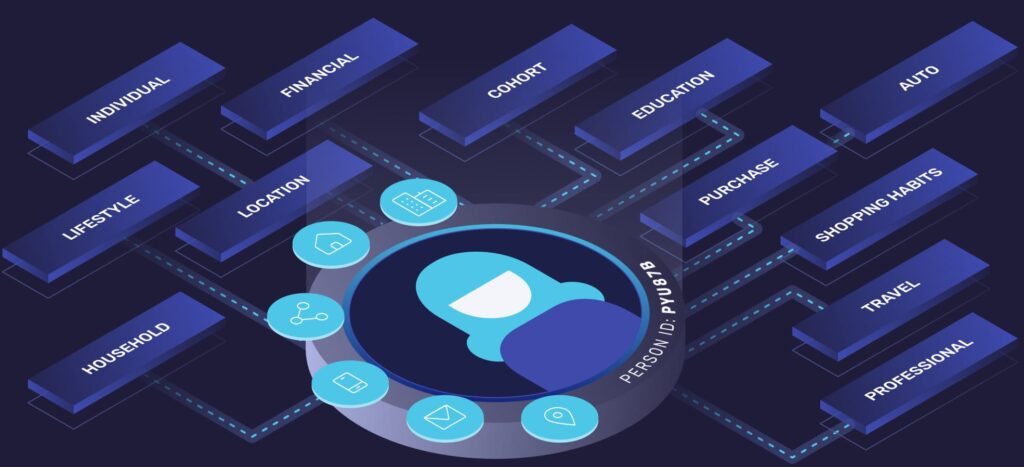
An identity graph works by linking multiple identifiers, such as email addresses, device IDs, cookies, phone numbers, and IP addresses, to a single unified profile representing one real individual. Rather than storing flat records, it maps the connections between these identifiers so that any one of them can resolve back to the same person in real time.
The graph is built through a combination of deterministic matching, where identifiers are directly tied together through confirmed signals like a login, and probabilistic matching, where behavioral and contextual signals suggest a likely connection. Over time, as more interactions are observed, the graph becomes richer and more accurate.
What makes an identity graph particularly powerful is its ability to recognize a person whether they are authenticated or anonymous. Someone browsing without logging in can still be connected to their known profile if enough signals align, enabling businesses to deliver relevant experiences even before a user identifies themselves.
What makes a customer database different from an identity graph?
A customer database stores structured records about known individuals, typically organized around a primary key like a customer ID or email address. An identity graph, by contrast, is built around relationships between identifiers rather than static records. The core difference is that a database answers “what do we know about this customer?” while an identity graph answers “is this the same person across all these touchpoints?”
Key distinctions include:
- Scope: Customer databases typically cover only authenticated, known users. Identity graphs span both known and anonymous interactions.
- Structure: Databases use rows and columns. Identity graphs use nodes and edges to represent relationships between identifiers.
- Flexibility: Adding a new identifier type to a database often requires a schema change. An identity graph is designed to absorb new signals natively.
- Resolution speed: Identity graphs are optimized for real-time lookup, returning a resolved profile in milliseconds rather than with batch queries.
A customer database is excellent for managing transactional data, purchase history, and customer service records. But it was never designed to handle the fragmented, multi-device nature of modern digital identity.
Can a customer database and identity graph work together?
Yes, and in practice they often should. A customer database and an identity graph serve complementary roles. The identity graph resolves who someone is across touchpoints, while the customer database stores what you know about them once they are identified. Together, they create a more complete and actionable picture of each individual.
For example, when a user interacts anonymously on a website, the identity graph can resolve their device ID to a known profile. That resolved identity can then be used to pull the relevant customer record from your database, enabling personalized messaging without requiring the user to log in again.
This combination is particularly valuable for omnichannel marketing, where a person might engage through a mobile app, a browser, an email, and an in-store visit. The identity graph stitches those touchpoints together; the customer database holds the history that makes personalization meaningful.
How FullContact helps with identity graph resolution
We built our Resolve platform specifically to bridge the gap between fragmented identifiers and unified, people-based profiles. Our identity graph has been developed over more than a decade and connects online and offline data around real individuals, not just devices or cookies. Here is what that means in practice:
- Real-time resolution: We return API responses in under 150 milliseconds, so identity resolution happens in the moment, not after the fact.
- Rich enrichment: We can append 900+ personal and professional insights to new and existing customer records, giving your database far more depth.
- Privacy-safe by design: Our approach keeps your customer data yours. You gain access to our identity graph without sharing your data with third parties.
Whether you are looking to improve personalization, reduce audience fragmentation, or connect anonymous and authenticated profiles, our platform is designed to make that possible. If you want to learn how identity resolution could work for your specific use case, feel free to contact us and we will walk you through it.
Related Articles
- Can small businesses benefit from using an identity graph?
- How do identity graph providers resolve anonymous and authenticated identifiers?
- What is a persistent identity graph and why does it matter?
- When should a business invest in an identity graph solution?
- What are the different types of data enrichment?