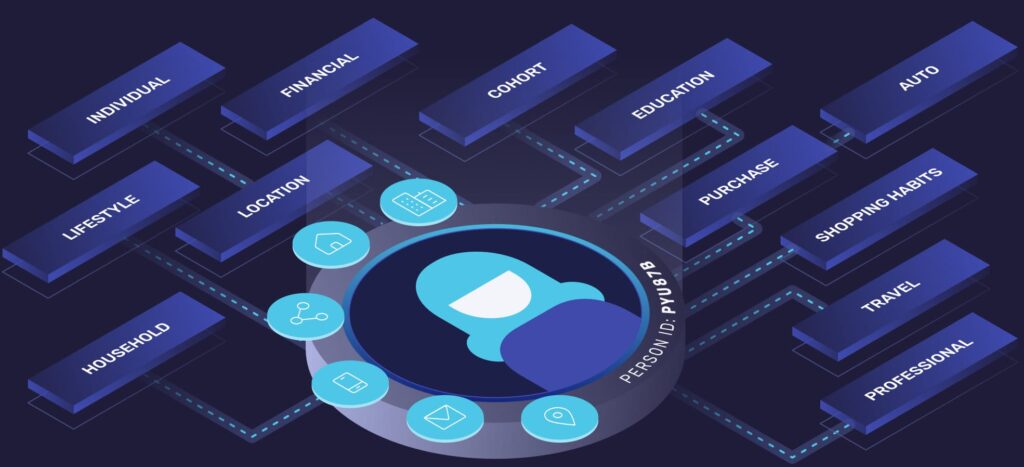
The future of personally identifiable information in identity resolution is moving decisively away from raw PII exposure and toward privacy-safe, consent-driven identity frameworks. As regulations tighten and third-party cookies disappear, businesses can no longer rely on openly passing around sensitive personal data to recognize their customers. Instead, the industry is converging on hashed identifiers, first-party data strategies, and persistent identity graphs that connect people to their digital behaviors without exposing the underlying personal details. The sections below unpack the three biggest questions shaping that shift right now.
How is PII being redefined in a cookieless world?
In a cookieless world, personally identifiable information is being redefined from a static set of raw data fields (names, email addresses, phone numbers) into a dynamic layer of hashed, tokenized, or pseudonymized signals that can still resolve a real person without exposing their sensitive details. The shift is less about collecting less data and more about how that data is handled, transformed, and matched at every step of the identity resolution process.
For most of the internet’s history, third-party cookies did the heavy lifting of recognizing users across sites. They stored identifiers directly in the browser, allowing advertisers and publishers to stitch together behavioral profiles with minimal friction. When that mechanism disappears, the industry loses its lowest-common-denominator method for cross-site identification, and PII suddenly has to work harder (and more carefully) to fill the gap.
Hashed identifiers are replacing raw data signals
Rather than passing a raw email address between platforms, modern identity resolution uses cryptographic hashing to convert that address into a fixed-length string that cannot be reverse-engineered without the original input. Hashed emails and phone numbers have become foundational to cookieless identity, appearing in clean room environments, data collaboration platforms, and publisher identity solutions alike. The underlying personal information still drives the match, but it never travels in a form that exposes the individual directly.
First-party data is now the primary PII source
Without third-party cookies, brands must rely on data collected directly from authenticated interactions: logins, newsletter signups, purchase histories, and loyalty programs. This first-party data is richer in consent signals and more durable than cookie-based identifiers, but it also tends to be fragmented across channels and systems. The challenge of unifying it into a single customer view is precisely why identity resolution has become a strategic priority rather than a technical afterthought. Personal information that a customer willingly provides during a genuine interaction carries both more accuracy and more regulatory legitimacy than passively harvested behavioral data ever did.
What regulations are reshaping how PII can be used in identity resolution?
Regulations including GDPR in Europe, CCPA and its successor CPRA in California, and a growing patchwork of state-level privacy laws in the United States are fundamentally reshaping how personally identifiable information can be collected, stored, matched, and shared in identity resolution workflows. These frameworks impose consent requirements, data minimization principles, and individual rights that force businesses to rethink how they build and maintain customer identity.
The core regulatory shift is from opt-out to opt-in. Under GDPR, processing personal data for marketing purposes generally requires a lawful basis, most commonly explicit consent or legitimate interest with a clear balancing test. CCPA and CPRA extend opt-out rights to the sale and sharing of personal information and introduce sensitive data categories that require explicit consent before processing. For identity resolution specifically, this means that linking a device identifier to a name and email address, then sharing that enriched profile with a downstream partner, now requires a documented legal basis at each step of the chain.
- Data minimization: Regulations require collecting only the personal information strictly necessary for a defined purpose, limiting the breadth of PII that can feed into an identity graph.
- Purpose limitation: Data collected for one use case (say, completing a purchase) cannot simply be repurposed for behavioral targeting without additional consent.
- Individual rights: Consumers can request access to, correction of, or deletion of their personal data, which means identity graphs must be structured to honor those requests without breaking core functionality.
- Cross-border transfer restrictions: Moving PII across jurisdictions, particularly from the EU to the US, requires specific legal mechanisms such as Standard Contractual Clauses or adequacy decisions.
Beyond these headline frameworks, sector-specific rules add further complexity. Financial services, healthcare, and telecommunications each carry their own data handling obligations that interact with general privacy law in ways that require careful legal mapping. The practical effect for identity resolution is that compliance is no longer a checkbox exercise: it is an architectural requirement that must be built into how identifiers are collected, matched, and governed from the ground up.
What’s the difference between PII-based and privacy-safe identity resolution?
PII-based identity resolution uses raw personal information (email addresses, names, phone numbers, physical addresses) as the direct matching keys to link records and build customer profiles. Privacy-safe identity resolution achieves the same goal of recognizing a real individual across touchpoints, but does so using transformed, consented, or anonymized signals that protect the underlying personal details throughout the process. The outcome can be functionally equivalent; the method and the risk profile are fundamentally different.
Traditional PII-based approaches are straightforward in concept: collect identifying information, match it against a reference dataset, and return an enriched profile. The problem is that raw PII creates exposure at every handoff. When a plain-text email address moves between a brand’s CRM, a data partner, and an activation platform, each transfer is a potential compliance liability and a security risk. If any node in that chain is breached or misuses the data, the individual’s personal information is directly compromised.
How privacy-safe resolution protects individuals without losing accuracy
Privacy-safe identity resolution replaces raw PII with transformed identifiers at the point of collection or as early in the workflow as possible. Common techniques include one-way hashing, tokenization, and differential privacy methods that allow matching to occur without either party in a data collaboration ever seeing the other’s underlying records. The match happens in an environment, sometimes called a clean room or a trusted execution environment, where only the result of the comparison is returned, not the personal data itself.
Consent architecture is the other defining feature of privacy-safe resolution. Rather than relying on inferred or assumed consent, privacy-safe systems are built around documented, auditable consent signals that travel with the identifier. This means that when a hashed email is used to resolve a customer across channels, the system can verify that the individual whose email was hashed actually agreed to that use. That consent trail is what makes the resolution both legally defensible and ethically sound.
Why the distinction matters for long-term identity strategy
Businesses that continue to rely on raw PII as their primary matching mechanism face compounding risk as regulations expand and consumer expectations around data privacy rise. Privacy-safe approaches, by contrast, are designed to remain functional even as the regulatory environment tightens, because they do not depend on the permissive data-sharing conditions that characterized the pre-GDPR era. An identity graph built on privacy-safe principles can absorb new consent requirements and jurisdictional rules without requiring a fundamental rebuild, giving organizations a more resilient foundation for long-term customer recognition.
How FullContact helps with privacy-safe identity resolution
We built our Resolve platform specifically to address the tension between accurate identity resolution and responsible personal data handling. Rather than asking businesses to choose between knowing their customers and protecting those customers’ privacy, we designed a system where both are achievable simultaneously. Here is what that looks like in practice:
- Real-time resolution without raw PII exposure: Our platform matches hashed identifiers against our identity graph in under 150 milliseconds, returning a unified customer profile without requiring raw personal information to travel between systems.
- 900+ enrichment attributes: We append personal and professional insights to new and existing customer records, enabling hyper-personalized experiences without expanding a brand’s own PII footprint.
- Privacy-by-design architecture: Our approach ensures that businesses can access the depth of our identity graph without surrendering their own data, maintaining a clean separation that supports regulatory compliance across jurisdictions.
If you are rethinking how your organization handles personally identifiable information in light of a cookieless landscape and evolving privacy regulations, we would love to help you find the right path forward. Contact us to start the conversation.