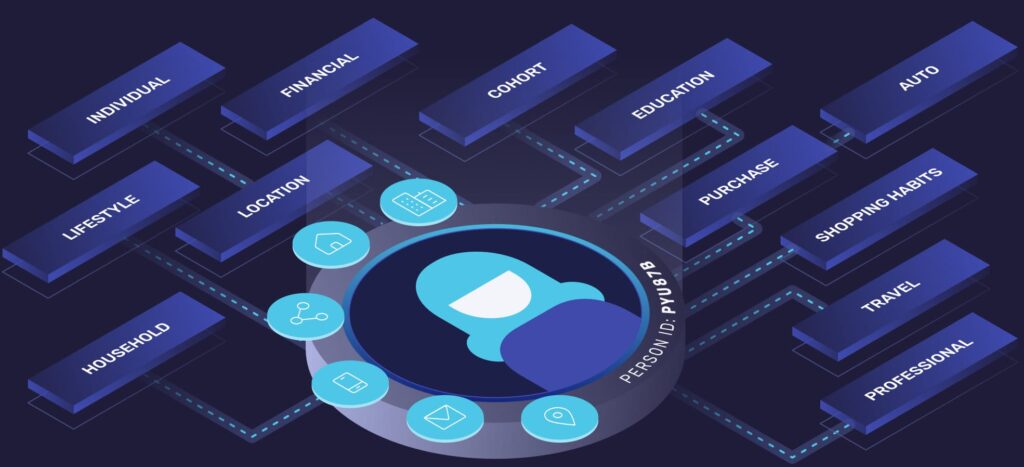
Marketers need to understand personally identifiable information rules because mishandling personal data exposes businesses to significant legal penalties, reputational damage, and broken consumer trust. Privacy regulations now govern how brands collect, store, and use personal data at every stage of the customer journey. The sections below break down what qualifies as PII in a marketing context, which regulations apply, and what the real consequences of non-compliance look like.
What counts as personally identifiable information in marketing?
Personally identifiable information, commonly abbreviated as PII, is any data that can be used on its own or in combination with other information to identify, contact, or locate a specific individual. In a marketing context, this definition is broader than most people expect, covering everything from an email address to a device fingerprint.
Marketers routinely collect and process several categories of PII without always recognizing them as such. The most obvious examples include names, email addresses, phone numbers, and postal addresses. These are sometimes called direct identifiers because they point to a specific person without needing any additional data.
Beyond the obvious, marketing data frequently contains indirect identifiers that become PII when combined with other information:
- IP addresses and device identifiers
- Cookie IDs and mobile advertising IDs
- Location data, including GPS coordinates and geofence records
- Behavioral data tied to a user profile, such as browsing history or purchase patterns
The distinction matters because many privacy laws apply the same protections to indirect identifiers as they do to a person’s name and address. A cookie ID on its own may seem harmless, but when it is linked to a purchase history, a location record, and a device type, it becomes a detailed portrait of a real individual. Regulators in most major markets now treat this kind of combined data as personally identifiable information, regardless of whether a name is attached.
Sensitive categories of PII attract even stricter rules. Health data, financial information, racial or ethnic origin, religious beliefs, and data relating to minors all fall into a higher-risk tier under most regulatory frameworks. Marketers who work with loyalty programs, healthcare brands, or children’s products need to apply additional caution when these categories appear in their data sets.
Which PII regulations apply to marketers?
The regulations that apply to marketers depend on where their customers are located, not just where the business is based. Most major privacy laws follow a territorial scope that covers any organization processing the personal data of people within a given jurisdiction, meaning a brand headquartered in one country can still be bound by the laws of another.
Key regulations by region
The General Data Protection Regulation (GDPR) is the most influential privacy law in the world and applies to any organization that processes the personal data of people in the European Union or European Economic Area. For marketers, GDPR requires a lawful basis for processing personal data, explicit consent for direct marketing in many cases, and clear privacy notices. It also grants individuals rights including access, correction, and erasure of their data.
In the United States, there is no single federal privacy law equivalent to GDPR, but a growing patchwork of state laws shapes how marketers must handle personally identifiable information. The California Consumer Privacy Act (CCPA) and its amendment, the California Privacy Rights Act (CPRA), are the most prominent. They give California residents the right to know what data is collected about them, to opt out of its sale, and to request deletion. Several other states including Virginia, Colorado, Connecticut, and Texas have passed comparable legislation, and the list continues to grow.
Sector-specific and channel-specific rules
Beyond broad privacy laws, marketers must also navigate rules tied to specific industries and communication channels. The CAN-SPAM Act governs commercial email in the United States, requiring honest subject lines, a clear sender identity, and a functional opt-out mechanism. The Telephone Consumer Protection Act (TCPA) restricts automated calls and text messages and requires prior express consent for marketing communications sent to mobile numbers.
Healthcare marketers must also comply with HIPAA, which restricts how protected health information can be used for marketing purposes, even when that data comes from third-party sources rather than a direct patient relationship. Financial services marketers face similar constraints under GLBA (the Gramm-Leach-Bliley Act), which governs how financial institutions share personal information.
The practical takeaway for most marketing teams is that compliance is not a single checkbox. It requires understanding which laws apply to each audience segment, each data source, and each marketing channel being used.
What happens when marketers mishandle PII?
When marketers mishandle personally identifiable information, the consequences fall into three broad categories: regulatory penalties, legal liability, and long-term damage to consumer trust. All three can be severe, and in practice they often arrive together rather than in isolation.
Regulatory fines under GDPR can reach up to 4% of a company’s global annual turnover or 20 million euros, whichever is higher. CCPA enforcement actions can result in fines of up to $7,500 per intentional violation, and because violations are often measured per consumer record rather than per incident, the total exposure can scale quickly. US state regulators have become increasingly active in pursuing enforcement actions, and federal regulators including the FTC have also pursued cases involving deceptive data practices.
Beyond fines, businesses face the risk of class action litigation. Several high-profile settlements in recent years have involved brands that collected or shared consumer data in ways that did not align with their stated privacy policies. Legal costs, settlement amounts, and the operational burden of responding to regulatory investigations can all significantly outweigh the short-term marketing benefit that prompted the data misuse in the first place.
The reputational consequences are harder to quantify but often more lasting. Research consistently shows that consumers are less willing to share data with brands they do not trust, and a publicized data breach or privacy scandal can accelerate customer churn while making new customer acquisition more expensive. In competitive markets, a reputation for responsible data handling has become a genuine differentiator, while a reputation for misuse becomes a liability that affects partnerships, investor confidence, and employee recruitment.
Common mishandling scenarios that marketers should actively work to avoid include:
- Collecting data without a clear lawful basis or valid consent mechanism
- Sharing or selling customer data to third parties without proper disclosure
- Retaining personal data longer than necessary for the stated purpose
- Failing to honor consumer opt-out or deletion requests within required timeframes
Operational failures are also a significant source of risk. Misconfigured tracking pixels, improperly anonymized data sets, and third-party vendor relationships that lack adequate data processing agreements have all led to regulatory action. Marketers who rely on complex data stacks with multiple technology partners need to ensure that PII protections extend across every integration in their ecosystem, not just the tools they control directly.
How FullContact helps marketers handle PII responsibly
We built FullContact around the principle that effective marketing and privacy protection are not in conflict. Our identity resolution platform is designed to help brands recognize and understand their customers without exposing or misusing personally identifiable information. Here is how we approach it in practice:
- Privacy-safe identity resolution: We match identifiers across devices and channels to build unified customer profiles without requiring brands to share their raw customer data with us or with third parties.
- Real-time enrichment without data leakage: Our API returns 900+ personal and professional insights in under 150 milliseconds, enabling personalization at scale while keeping your customer data inside your own environment.
- A true identity graph, not a customer database: Our Identity Graph connects online and offline signals around real individuals, giving marketers a more complete picture of who they are reaching without relying on fragmented or unreliable data sources.
- Compliance-aligned architecture: Our platform is built to support privacy-safe data practices, making it easier for marketing teams to operate within regulatory frameworks rather than around them.
If your team is working through the challenges of unifying customer data while staying on the right side of privacy regulations, we would be glad to walk you through how our approach works in practice. Feel free to contact us and start the conversation.