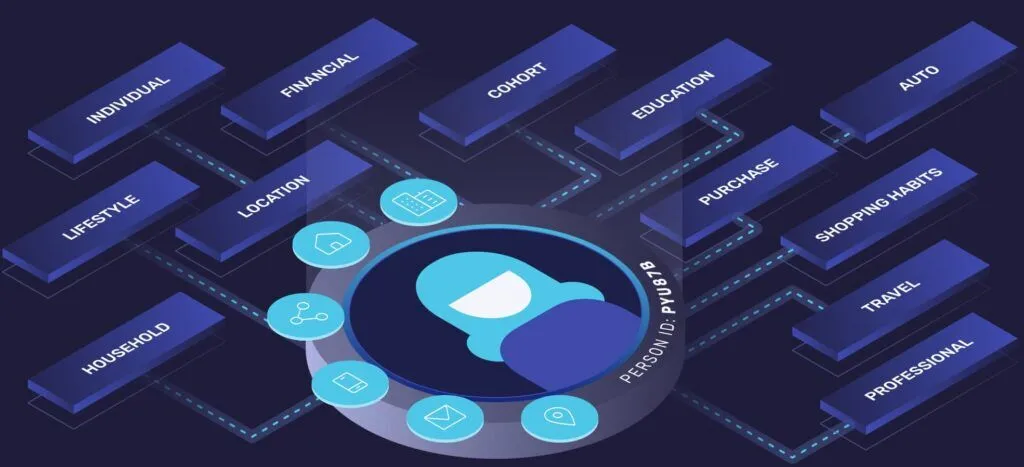
Real-time APIs protect personally identifiable information by combining encryption in transit, token-based authentication, and strict access controls that prevent raw PII from being exposed during the data exchange. These protections operate at the protocol level, meaning they activate automatically with every API call rather than requiring manual intervention. The sections below unpack the specific mechanisms, data handling strategies, and compliance frameworks that govern PII security in real-time identity resolution contexts.
What methods do real-time APIs use to protect PII in transit?
Real-time APIs protect personally identifiable information in transit primarily through transport layer security (TLS), which encrypts data between the client and the server so that intercepted packets are unreadable. Beyond encryption, APIs use token-based authentication, payload hashing, and API gateway controls to ensure that only authorized systems can send or receive sensitive data.
Each of these methods addresses a different attack surface. TLS handles eavesdropping on the network. Authentication tokens prevent unauthorized callers from reaching the endpoint in the first place. Payload hashing confirms that data has not been tampered with between origin and destination. Together, they create layered protection rather than relying on any single safeguard.
Transport layer encryption and certificate validation
TLS 1.2 and 1.3 are the current standards for encrypting API traffic. When a client initiates a connection, the server presents a digital certificate that proves its identity. The client validates that certificate against a trusted authority before any data is exchanged. This handshake prevents man-in-the-middle attacks, where a third party tries to intercept or alter the communication.
Certificate pinning adds an additional layer in high-sensitivity environments. Rather than trusting any certificate issued by a recognized authority, the client is configured to accept only a specific certificate or public key. This makes it significantly harder for an attacker to substitute a fraudulent certificate, even if they compromise a certificate authority.
Token-based authentication and access scoping
API keys, OAuth tokens, and JSON Web Tokens (JWTs) each serve the same fundamental purpose: they confirm that the caller has permission to access the endpoint before any personally identifiable information is transmitted. The critical distinction between these approaches lies in scope. A well-designed authentication system issues tokens with the minimum permissions needed for a specific task, so a compromised token cannot be used to access data beyond its defined scope.
Short-lived tokens reduce exposure further. If a token is stolen, its usefulness is limited to a narrow time window. Combining short expiry with refresh token rotation means that even a successful credential theft has limited impact on the PII the API handles.
How does data minimization reduce PII exposure in API calls?
Data minimization reduces personally identifiable information exposure by limiting what is transmitted in each API call to only the identifiers strictly necessary to complete the requested operation. When an API request contains only a hashed email address or a pseudonymous device identifier rather than a full name, address, and contact details, the potential harm from a breach or interception is substantially smaller.
This principle shapes API design at a fundamental level. Rather than sending a complete customer record and asking the server to find a match, a well-designed identity API accepts a single identifier, resolves it server-side, and returns only the attributes the calling system needs. The raw PII never travels across the network in full form.
Hashing and pseudonymization before transmission
Hashing converts a piece of PII, such as an email address, into a fixed-length string that cannot be reversed into the original value without significant computational effort. When APIs accept hashed identifiers rather than plaintext ones, the original personal data stays on the client side. The server works with the hash, matches it against its own hashed records, and returns a result without either party needing to expose the underlying PII.
Pseudonymization replaces direct identifiers with surrogate keys or tokens that have meaning only within a controlled system. A pseudonymous identifier can be used to link records and personalize experiences without revealing the individual’s actual name, email, or phone number to every system in the data flow. This is particularly valuable in multi-vendor architectures where API calls pass through several services before completing.
Field-level filtering and response scoping
Data minimization also applies to what the API returns, not just what it receives. Response scoping means the API delivers only the fields the requesting system has both permission and legitimate need to receive. A fraud prevention system may need a risk score but not a customer’s full address history. A personalization engine may need demographic attributes but not financial identifiers.
Field-level filtering at the API gateway enforces this automatically, stripping attributes from responses before they reach the client. This reduces the volume of personally identifiable information circulating across systems and limits the blast radius if any single system in the chain is compromised.
What compliance frameworks govern PII handling in identity resolution APIs?
PII handling in identity resolution APIs is governed by a combination of regional data protection laws, industry standards, and sector-specific regulations. The most influential are the General Data Protection Regulation (GDPR) in Europe, the California Consumer Privacy Act (CCPA) in the United States, and standards such as ISO 27001 and SOC 2 Type II that set operational security requirements regardless of geography.
These frameworks do not operate in isolation. An identity resolution platform serving customers in multiple regions must satisfy the requirements of each applicable jurisdiction simultaneously, which means building compliance into the API architecture rather than treating it as an afterthought.
GDPR and purpose limitation in API design
GDPR requires that personal data be collected for specified, explicit, and legitimate purposes and not processed in ways incompatible with those purposes. For real-time APIs, this translates directly into purpose limitation at the technical level: the API should only resolve or enrich identifiers for the use case the data subject consented to. Sending the same identifier to multiple downstream systems for unrelated purposes violates this principle, even if each individual call appears legitimate in isolation.
GDPR also establishes rights for individuals, including the right to erasure. APIs operating within GDPR scope need mechanisms to propagate deletion requests through the identity graph so that a single request removes the individual’s data from every connected record, not just the primary database.
CCPA and consumer opt-out mechanisms
The CCPA gives California consumers the right to know what personal information is collected about them, to delete it, and to opt out of its sale or sharing. For identity resolution APIs, the practical implication is that opt-out signals must be respected in real time. If a consumer has opted out of data sharing, API calls that would otherwise resolve or enrich that individual’s profile must return a suppressed or null result rather than proceeding as normal.
The American Privacy Rights Act and state-level privacy laws passed across the United States in recent years have extended similar frameworks beyond California, meaning that opt-out handling is increasingly a baseline requirement rather than a California-specific edge case.
SOC 2 Type II and operational security standards
SOC 2 Type II certification demonstrates that an organization has maintained security controls over an extended audit period, typically six to twelve months, rather than simply passing a point-in-time assessment. For API providers handling personally identifiable information, this certification signals that access controls, monitoring, incident response, and data handling practices meet independently verified standards.
ISO 27001 operates similarly, providing a framework for information security management that covers the full lifecycle of data, from collection through deletion. When evaluating an identity resolution API provider, these certifications offer meaningful evidence that compliance is embedded in operations rather than documented on paper alone.
How FullContact helps protect personally identifiable information in real-time identity resolution
We built our platform around the principle that identity resolution and privacy protection are not competing priorities. Our Identity Graph resolves identifiers in real time without requiring clients to share their raw customer data with us, which means your PII stays in your environment while we do the matching work on our side. Here is how that translates into practice:
- API responses delivered in under 150 milliseconds with encryption and authentication controls applied to every call
- Pseudonymous identifier matching that keeps plaintext PII out of the data exchange
- Privacy-safe architecture designed to support GDPR, CCPA, and emerging state-level privacy requirements
- Access to 900+ personal and professional attributes appended to customer records without exposing your underlying data
Our approach means you can enrich customer profiles, unify fragmented identifiers, and deliver personalized experiences without compromising the security of the personally identifiable information your customers have trusted you with. If you want to understand how our platform fits your specific compliance environment and technical stack, we would be glad to walk you through it: feel free to contact us and start the conversation.
Related Articles
- How do identity graphs connect online and offline customer data?
- How do you choose the right data enrichment service for your business?
- How accurate are third-party data enrichment services?
- What machine learning models improve sales intelligence accuracy?
- How do you identify qualified leads with software?