Personally identifiable information, or PII, plays a central role in both fraud prevention and identity verification by giving businesses the data points they need to confirm that someone is who they claim to be. When organizations can match a person’s name, contact details, device signals, or behavioral patterns against trusted records, they gain the ability to flag inconsistencies that suggest fraudulent activity. The sections below break down exactly how PII functions in fraud detection, which data types carry the most weight, and how to use that information without putting privacy at risk.
How does PII actually detect and prevent fraud?
PII detects and prevents fraud by enabling businesses to cross-reference the information a person provides against known, verified records. When the details match, confidence in that person’s identity increases. When they conflict, that mismatch becomes a signal worth investigating. The more data points that can be validated simultaneously, the harder it becomes for a bad actor to fabricate a convincing identity.
Fraud rarely looks obviously wrong in isolation. A stolen name is just a name. A compromised email address is just an email address. The power of personally identifiable information in fraud prevention comes from correlation: combining multiple identifiers and checking whether they behave consistently over time and across channels.
Real-time verification as a fraud barrier
One of the most effective uses of PII in fraud prevention is real-time identity verification at the point of a transaction or account creation. When a new user submits a name, phone number, and email address, that bundle of information can be checked instantly against a reliable identity graph to assess whether those details have ever appeared together in a legitimate context. If a phone number has never been associated with that name, or if the email address was created moments before the transaction, those are meaningful risk indicators.
Speed matters here. Fraud attempts are often automated, and a verification process that takes seconds rather than minutes can interrupt an attack before it succeeds. Real-time API-based identity resolution makes this kind of instant cross-referencing practical at scale.
Behavioral and historical signals
Beyond point-in-time checks, PII also supports ongoing fraud monitoring through behavioral analysis. When a customer’s personally identifiable information is tied to a persistent profile, unusual activity becomes detectable. A billing address that suddenly changes, a new device linked to an old account, or an email address used across dozens of suspicious accounts are all patterns that emerge only when PII is tracked consistently over time.
This longitudinal view is what separates reactive fraud detection from proactive prevention. Businesses that maintain rich, connected identity records can spot anomalies before they escalate into losses.
What types of PII are most critical for identity verification?
The most critical types of PII for identity verification are those that are difficult to fabricate, rarely shared between individuals, and stable over time. Contact identifiers like email addresses and phone numbers, combined with biographical details like full name and date of birth, form the foundation. Device and behavioral signals add a further layer of confidence that no single data point can provide on its own.
Not all personally identifiable information carries equal weight. Some identifiers are easy to fake or frequently recycled, while others are deeply tied to a specific individual’s history. Understanding which types of PII do the most work in verification helps businesses prioritize their data collection and matching strategies.
- Full name and date of birth: Biographical anchors that allow cross-referencing against public and private records. Alone they are insufficient, but combined with other signals they significantly narrow the identity space.
- Email address and phone number: Contact identifiers that are often linked to financial accounts, social profiles, and device registrations, making them strong connective tissue in an identity graph.
- Physical address: A stable identifier that can be validated against property and mailing records, and that often reveals geographic inconsistencies when fraud is present.
- Device identifiers and IP address: Technical signals that tie a person’s online activity to specific hardware and locations, helping to detect account takeovers and synthetic identity fraud.
The real verification power comes from linking these identifiers together rather than evaluating any one of them in isolation. An email address that matches a name, which in turn matches a phone number registered to the same address, creates a coherent identity picture. Gaps or contradictions in that picture are where fraud hides.
It is also worth noting that the value of any PII type depends on the quality and breadth of the reference data it is checked against. A name matched against a shallow database produces a weaker signal than the same name matched against a deep, well-maintained identity graph built from diverse, real-world data sources.
How can businesses use PII responsibly without compromising privacy?
Businesses can use PII responsibly for fraud prevention and identity verification by applying the principles of data minimization, purpose limitation, and privacy-safe resolution. This means collecting only the identifiers genuinely needed for a specific use case, processing them in ways that protect individual privacy, and working with resolution frameworks that do not expose raw personal data unnecessarily.
The tension between effective identity verification and privacy protection is real, but it is not irresolvable. The key is building processes and partnerships that treat privacy as a design requirement rather than an afterthought.
Data minimization and purpose limitation
Collecting more PII than a task requires creates unnecessary risk, both for the individuals whose data is held and for the organization responsible for protecting it. A responsible approach starts with clearly defining the purpose of each data collection point and then gathering only the identifiers that directly serve that purpose. Verification of a shipping address, for example, does not require access to a customer’s full financial history.
Purpose limitation also means that PII collected for fraud prevention should not be repurposed for unrelated marketing activities without appropriate consent. Keeping these use cases clearly separated reduces regulatory exposure and builds the kind of trust that encourages customers to engage honestly.
Privacy-safe resolution and consent frameworks
Modern identity resolution can be performed in ways that protect individual privacy by design. Rather than sharing raw personal data across systems or third parties, privacy-safe approaches resolve identities using tokenized or hashed identifiers, meaning the underlying PII never needs to leave a controlled environment to produce a useful match signal.
Consent frameworks matter equally. When customers understand why their information is being used and have actively agreed to that use, the relationship between data collection and trust strengthens rather than erodes. Transparent privacy policies, clear opt-in mechanisms, and straightforward data rights processes are not just compliance requirements. They are competitive advantages in an environment where consumer trust is increasingly difficult to earn.
Regulatory frameworks such as GDPR in Europe and CCPA in California have formalized many of these principles into legal obligations, but businesses that go beyond minimum compliance tend to see better long-term outcomes. Customers who trust a brand with their personally identifiable information are more likely to provide accurate data, which in turn improves the quality of verification and fraud detection.
How FullContact helps with PII-based fraud prevention and identity verification
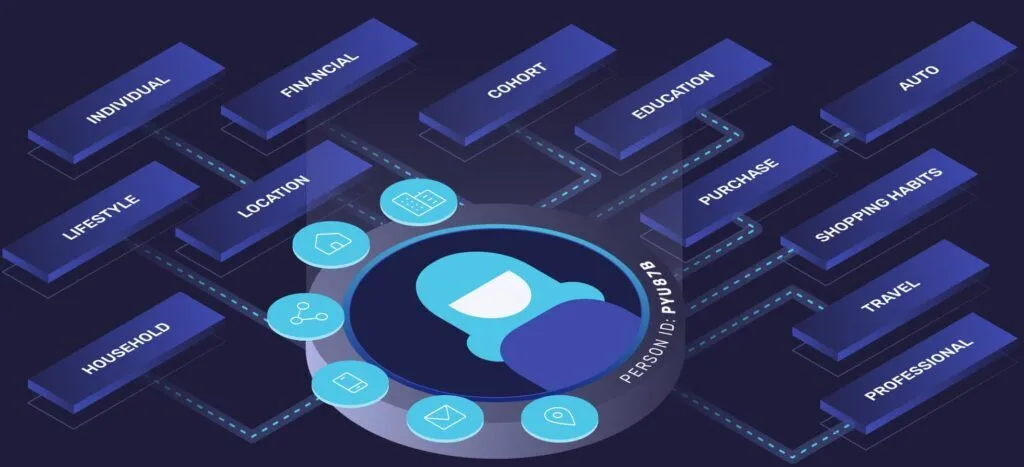
We built our Resolve platform specifically to help businesses get the most out of personally identifiable information without creating privacy risks or data security vulnerabilities. Our approach connects the identifiers your customers provide (email addresses, phone numbers, names, physical addresses, and device signals) to a decade-deep identity graph that spans online and offline data, all centered on real individuals rather than fragmented device records.
- Real-time resolution: Our API returns identity matches in under 150 milliseconds, making it practical to verify identities and flag anomalies at the exact moment a transaction or account event occurs.
- Privacy-safe architecture: We resolve identities using privacy-preserving methods that keep raw PII protected, so you gain the verification signal you need without exposing sensitive data unnecessarily.
- 900+ enrichment attributes: Beyond basic verification, we can append professional and personal insights to a customer record, giving your fraud and identity teams a richer picture of who they are dealing with.
- No data sharing: Your customer data stays yours. We provide access to our identity graph without requiring you to contribute your own data to it.
If you are evaluating how personally identifiable information can strengthen your fraud prevention or identity verification workflows, we would be glad to walk you through what this looks like in practice. Feel free to contact us and start the conversation.