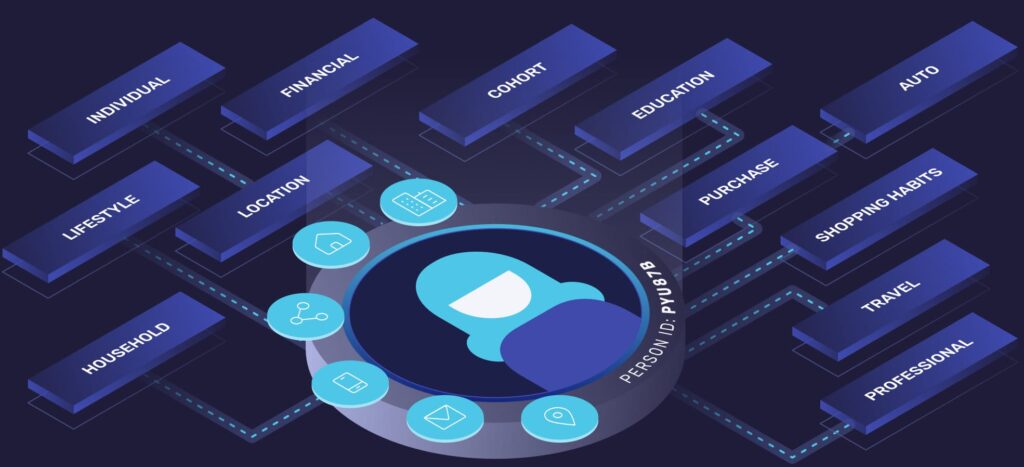
Yes, an identity graph can meaningfully help with fraud prevention. By linking multiple identifiers, such as email addresses, device IDs, phone numbers, and behavioral signals, to a single verified individual, an identity graph makes it far harder for bad actors to operate undetected. It gives organizations a richer, more connected view of who they are really dealing with at every touchpoint.
Unlike single-signal fraud checks, an identity graph draws on the relationships between identifiers to surface inconsistencies that would otherwise go unnoticed. The sections below break down exactly how that works, what kinds of fraud it addresses, and how it differs from traditional fraud databases.
How does an identity graph detect fraudulent activity?
An identity graph detects fraudulent activity by mapping the connections between known identifiers and flagging patterns that do not match the expected profile of a legitimate user. When a new interaction arrives, a login, a transaction, an account creation, the graph checks that identifier against a web of linked data points. Inconsistencies in those connections are strong signals that something is wrong.
At its core, the detection mechanism relies on the idea that real people leave consistent, coherent trails across their digital and offline lives. A genuine customer tends to use the same email across multiple authenticated interactions, their device history aligns with their location data, and their behavioral patterns are stable over time. A fraudster, by contrast, typically presents a thin or contradictory identity: a fresh email address with no history, a device that has never appeared before, or a phone number that is not associated with any other known identifiers.
Anomaly detection through connected data
When an identity graph receives a new identifier, it does not evaluate that identifier in isolation. It queries the graph to understand what else is connected to it. If an email address links to dozens of different device IDs, or a phone number appears alongside hundreds of unrelated names, those relationships are anomalous. The graph surfaces these patterns in real time, giving fraud teams and automated systems a clear signal to act on before damage is done.
Real-time resolution at the moment of interaction
Speed matters in fraud prevention. The most effective identity graphs return resolution results fast enough to influence a decision at the point of interaction, during checkout, at account creation, or at login. A slow lookup is nearly as unhelpful as no lookup at all, because fraudulent transactions happen in seconds. Real-time identity resolution means that risk scoring and verification can happen within the same session, not after the fact.
What types of fraud can an identity graph help prevent?
An identity graph is particularly effective against fraud that relies on identity manipulation, where the attacker creates, borrows, or fragments an identity to avoid detection. This includes account takeover, synthetic identity fraud, new account fraud, and promo abuse, among others. Any fraud type that depends on an attacker appearing to be someone they are not is vulnerable to the pattern-matching capabilities of a well-built identity graph.
Here is a closer look at the most common fraud types where identity graphs add meaningful protection:
- Account takeover fraud: When a legitimate account is accessed by an unauthorized party, the identity graph can detect that the incoming identifiers, device, location, behavioral signals, do not match the established profile of the real account holder.
- Synthetic identity fraud: Fraudsters combine real and fabricated information to create a new identity. An identity graph can reveal that the combination of identifiers has no consistent history, making the synthetic nature of the identity visible.
- New account fraud: Fraudsters open accounts with stolen or fabricated credentials. A graph that checks the depth and consistency of an identity’s connections can flag thin or implausible profiles before an account is approved.
- Promo and bonus abuse: Repeat bad actors who exploit offers by creating multiple accounts often reuse identifiers across those accounts. An identity graph can link those accounts together and identify the pattern.
What makes an identity graph especially valuable here is that it addresses fraud at the identity layer rather than the transaction layer. Many fraud tools focus on detecting suspicious behavior during a specific event. An identity graph goes further by questioning whether the identity presenting itself is coherent and trustworthy in the first place.
How is an identity graph different from a fraud database?
A fraud database is a list of known bad identifiers: flagged email addresses, blacklisted IP addresses, stolen card numbers. An identity graph is a dynamic, relational structure that maps how identifiers connect to one another across a real population of individuals. The key difference is that a fraud database tells you whether something is known to be bad, while an identity graph tells you whether something is consistent with being real and legitimate.
Fraud databases are reactive by nature. They catch fraud after it has already been identified and catalogued somewhere. If a fraudster uses a brand-new email address that has never appeared on a blocklist, a fraud database will not flag it. An identity graph, on the other hand, can evaluate that email address against the broader web of identifiers it connects to, or fails to connect to, and surface the absence of a credible identity history as a risk signal in itself.
Coverage of unknown threats
Because an identity graph evaluates the coherence and depth of an identity rather than matching against a static list, it is far better equipped to handle previously unseen fraud attempts. A new synthetic identity, a freshly created email, or a device that has never been seen before will have no entry in a fraud database. But within an identity graph, the absence of meaningful connections, or the presence of suspicious ones, is itself a meaningful signal.
Enrichment versus exclusion
Fraud databases are primarily exclusion tools: they tell you what to block. Identity graphs are enrichment tools: they tell you more about who you are dealing with. That richer picture supports more nuanced risk decisions. Instead of a binary block-or-allow outcome, organizations can use identity graph data to trigger additional verification steps for identities that fall into a grey area, reducing both fraud losses and the friction imposed on legitimate customers.
How FullContact helps with identity-based fraud prevention
We built FullContact’s Resolve platform specifically to give organizations the kind of deep, real-time identity intelligence that makes fraud prevention more accurate and less disruptive to genuine customers. Our identity graph has been developed over more than a decade, connecting online and offline data around real individuals, not just device signals or transactional records.
Here is what that means in practice for fraud prevention:
- Real-time API responses in under 150 milliseconds, so identity resolution happens at the moment of interaction, not after the fact.
- 900+ personal and professional insights appended to identity records, giving risk teams a far richer picture of whether an identity is coherent and trustworthy.
- Cross-device and cross-identifier matching that links authenticated and anonymous signals into a single customer profile, surfacing inconsistencies that single-point checks would miss.
Our approach is also privacy-safe by design, which means stronger fraud protection does not come at the cost of compliance or customer trust. If you want to understand how our identity graph could fit into your fraud prevention strategy, we would be glad to walk you through it; feel free to contact us and start the conversation.