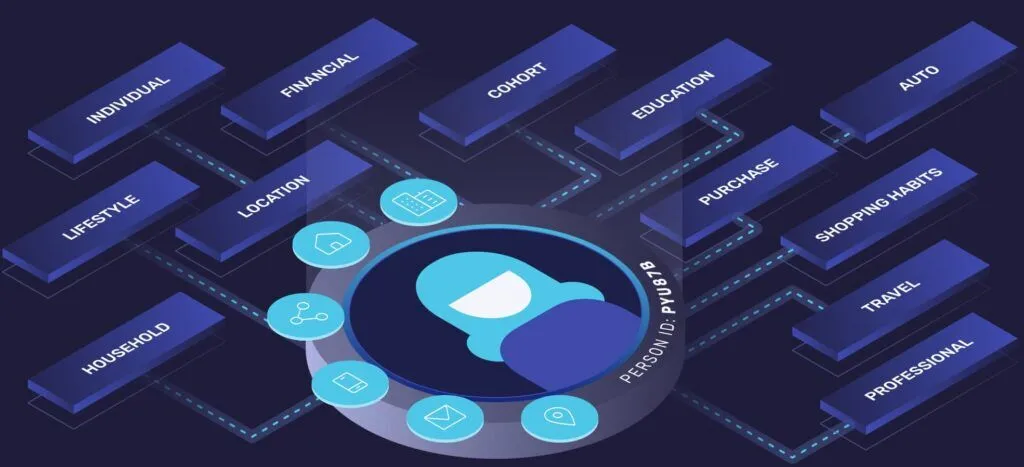
Yes, you can build a customer profile without storing raw personally identifiable information directly. Modern identity resolution techniques let businesses work with hashed, tokenized, or pseudonymized identifiers that represent a real person without ever exposing their name, email address, or other sensitive data in plain text. This approach is not only technically sound but increasingly the standard for privacy-conscious data practices. The questions below unpack exactly how it works, what replaces raw personally identifiable information, and whether the resulting profiles are reliable enough to act on.
What types of data can replace raw PII in a customer profile?
Several categories of identifiers can replace raw personally identifiable information in a customer profile while still enabling accurate recognition of real individuals. These include cryptographic hashes of email addresses or phone numbers, device identifiers, behavioral signals, and probabilistic linkage tokens. Each type carries enough signal to connect interactions to a person without storing their data in a readable, exposed format.
To understand why these alternatives work, it helps to think about what raw personally identifiable information actually does in a profile: it acts as a stable anchor that ties different interactions to the same person. Anything that performs that anchoring function reliably can serve the same purpose. Here are the main categories businesses use:
- Hashed identifiers: A one-way cryptographic hash of an email address or phone number produces a fixed-length string that cannot be reversed to reveal the original value, but can be matched against another hash of the same input.
- Device and browser signals: Cookies, mobile advertising IDs, and browser fingerprints link sessions and behaviors to a consistent device without naming the person behind it.
- Pseudonymous tokens: Internally generated tokens replace raw fields in a database, with the mapping to real data held separately under strict access controls or discarded entirely.
- Probabilistic linkage signals: Location patterns, behavioral sequences, and contextual attributes can be combined to infer identity with high confidence even when no direct identifier is present.
The practical implication is that a customer profile built on these inputs can contain rich behavioral, demographic, and preference data without a single field that reads as a name, address, or email in plain text. The profile still describes a real person accurately enough to personalize experiences and measure engagement. The raw personally identifiable information, if it was ever collected, can be hashed or tokenized at the point of ingestion so it never travels through downstream systems in its original form.
It is also worth noting that not all of these signals carry equal weight. Hashed first-party identifiers, particularly hashed email addresses, are generally the strongest because they are deterministic: the same input always produces the same hash, so matching across systems is reliable. Probabilistic signals are valuable for filling gaps but introduce some degree of uncertainty that needs to be managed through confidence scoring.
How does identity resolution work without storing raw PII?
Identity resolution without storing raw personally identifiable information works by matching pseudonymized or hashed identifiers against an external identity graph rather than against a local database of plain-text personal data. The business sends a tokenized or hashed signal to the resolution layer, which returns a persistent, privacy-safe identifier linking that signal to a unified person-level record. No raw personally identifiable information is exchanged or retained in the process.
The matching process
When a user interacts with a website, app, or connected device, their action generates one or more identifiers: a hashed email from a login event, a mobile advertising ID from an app session, or a cookie from a web visit. These identifiers are passed to an identity resolution system, which attempts to find a match within its graph. If a match is found, the system returns a stable person-level key that the business can use to recognize that individual across future interactions without needing to store or re-process their raw personally identifiable information.
The resolution happens in real time, often in well under a second, so the business can act on the recognition immediately: personalizing a landing page, suppressing a redundant ad impression, or triggering a relevant follow-up. The critical point is that the business never needs to hold the underlying personal data itself. The identity graph does the heavy lifting, and the business works only with the resolved key and the enriched attributes attached to it.
How authenticated and anonymous signals are bridged
One of the harder problems in privacy-safe identity resolution is connecting authenticated moments, when a user logs in and provides an identifier, with anonymous ones, when they browse without signing in. Without storing raw personally identifiable information, this bridging relies on the identity graph having already established probabilistic or deterministic links between device signals and person-level records.
When a user authenticates, their hashed identifier anchors the session to a known record. When they browse anonymously on a different device, the graph uses overlapping signals, shared location patterns, device co-occurrence, and behavioral similarity to infer that the anonymous session likely belongs to the same person. The business receives a single resolved key for both sessions without ever seeing the underlying personal data that made the connection possible. This is what allows omnichannel profiles to stay coherent even when users move between logged-in and logged-out states.
Is a customer profile built without raw PII still accurate enough to use?
Yes, a customer profile built without storing raw personally identifiable information is accurate enough for the vast majority of marketing, personalization, and fraud prevention use cases. The accuracy depends on the quality of the identity graph powering the resolution and the richness of the input signals available, not on whether raw personally identifiable information is stored locally. Deterministic matching on hashed first-party identifiers can achieve accuracy comparable to working with plain-text data directly.
The honest answer is that accuracy exists on a spectrum, and where a specific profile lands on that spectrum depends on a few key factors:
- Signal richness: Profiles anchored by a hashed email or phone number, combined with device and behavioral data, tend to be highly accurate because the deterministic anchor reduces ambiguity.
- Graph depth: The underlying identity graph needs sufficient historical linkage data to make confident connections, particularly for probabilistic matching of anonymous signals.
- Freshness: People change devices, email addresses, and behaviors over time. Profiles that draw on a continuously updated graph stay accurate longer than those built on static snapshots.
For most practical applications, the accuracy of a privacy-safe profile is more than sufficient. Personalization decisions do not require certainty at the level of a legal identity verification; they require enough confidence to serve a relevant message or suppress an irrelevant one. A profile that correctly identifies someone’s category of interest, their likely device ecosystem, and their recent behavioral patterns enables meaningful personalization even if it carries a small margin of uncertainty at the edges.
Where higher precision is genuinely required, such as in fraud detection or compliance-sensitive contexts, the answer is not to reintroduce raw personally identifiable information but to increase the number and quality of input signals feeding the resolution layer. More signal reduces uncertainty without compromising the privacy architecture that makes the approach defensible in the first place.
It is also worth acknowledging that profiles built without raw personally identifiable information can sometimes be more useful than those built on raw data alone, because they force the system to draw on behavioral and contextual signals that are often more predictive of intent than demographic fields. A person’s browsing pattern and device usage often reveal more about what they need right now than their name and postal address do.
How FullContact helps you build accurate profiles without raw PII
We built our Resolve platform specifically to solve this challenge at scale. Rather than asking businesses to store and manage raw personally identifiable information themselves, we provide a real-time identity resolution layer that works with hashed and tokenized inputs and returns enriched, person-level insights without exposing underlying sensitive data. Here is what that looks like in practice:
- Real-time resolution under 150ms: We match hashed identifiers against our identity graph and return a stable person-level key fast enough to act on within a single session or page load.
- 900+ enriched attributes: Resolved profiles can be appended with personal and professional insights that add depth without requiring you to collect or store the underlying personally identifiable information yourself.
- Privacy-safe by design: Your data stays yours. We do not absorb your customer data into our graph, and our architecture is built to support compliance with evolving privacy regulations.
- Authenticated and anonymous bridging: We connect logged-in and anonymous sessions into a single coherent profile, so your understanding of a customer does not reset every time they browse without signing in.
If you are evaluating whether a privacy-safe identity resolution approach can meet your accuracy and personalization requirements, we would be glad to walk through it with you. Contact us and we can look at your specific use case together.