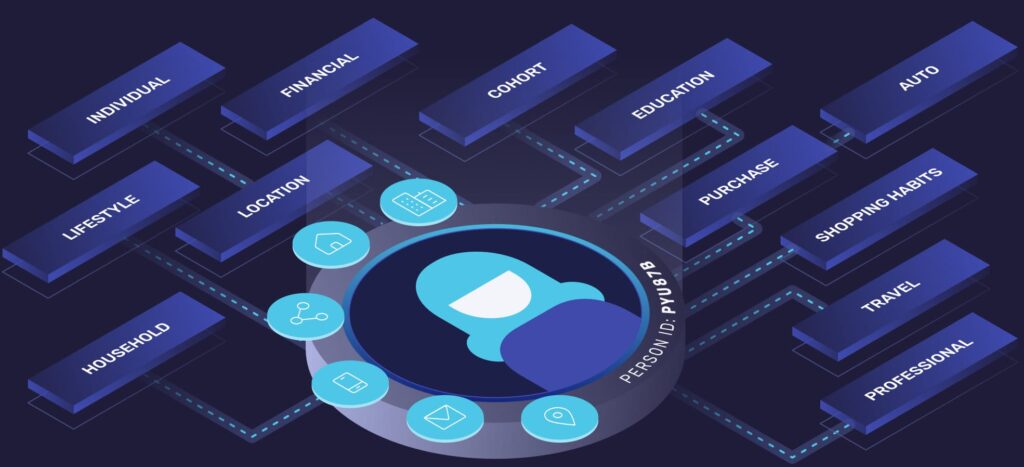
Identity resolution reduces reliance on raw personally identifiable information by replacing direct data points like names, email addresses, and phone numbers with persistent, privacy-safe identifiers that still allow businesses to recognize and engage individual customers. Rather than storing sensitive data in its original form, identity resolution links anonymized tokens and pseudonymous identifiers across touchpoints, maintaining recognition without retaining exposure. The sections below unpack how this works across different types of personal data, the mechanics of identity graphs, and the regulatory context driving this shift.
What types of PII does identity resolution help replace?
Identity resolution helps replace direct personally identifiable information such as full names, email addresses, phone numbers, and physical addresses with persistent, tokenized identifiers that carry the same recognition value without exposing the underlying sensitive data. This substitution allows businesses to maintain a continuous view of a customer across sessions and channels without holding raw PII in operational systems.
The categories of personally identifiable information that identity resolution can effectively abstract away from include both online and offline identifiers. On the digital side, raw email addresses and phone numbers are among the most common targets. Instead of passing a customer’s actual email through advertising platforms, data clean rooms, or analytics pipelines, identity resolution converts it into a hashed or tokenized form that can still be matched to a known profile without the original value being readable or recoverable.
Offline identifiers present a similar opportunity. Mailing addresses, loyalty card numbers, and even device-level identifiers collected in physical retail environments can be resolved into a shared identity record without that raw data needing to travel across systems. Once a person is resolved to a persistent identity node, downstream processes reference that node rather than the underlying personal detail.
Beyond contact data, identity resolution also reduces operational dependence on device identifiers that carry personal data by association. IP addresses, cookie values, and mobile advertising IDs are all forms of personally identifiable information under many regulatory frameworks. By mapping these to a pseudonymous identity cluster, businesses can recognize returning users and build behavioral context without continuously re-collecting and storing the raw identifiers themselves.
- Email addresses and phone numbers replaced with hashed or tokenized equivalents
- Physical addresses abstracted into resolved identity nodes shared across systems
- Device identifiers like IP addresses and cookie values mapped to pseudonymous profiles
- Offline loyalty and transaction data linked without raw PII traversing platforms
The practical result is that marketing, analytics, and personalization workflows can continue operating with full customer recognition while the systems themselves hold far less raw personally identifiable information than they otherwise would. This reduces both the risk surface in the event of a data breach and the compliance burden associated with managing sensitive data at scale.
How does an identity graph work without storing raw PII?
An identity graph works without storing raw personally identifiable information by building a network of relationships between anonymized or hashed identifiers rather than between the original data points themselves. Each node in the graph represents a persistent identity, and the edges connecting nodes represent verified links between identifiers. The raw PII used to establish those links is processed transiently and is not retained in the graph’s operational layer.
The process begins at the point of data ingestion. When a business submits an identifier, such as an email address, to an identity resolution system, that value is typically hashed using a one-way cryptographic function before it enters the graph. The hash is deterministic, meaning the same input always produces the same output, which allows matching across sources. But the hash cannot be reversed to recover the original email address, which means the graph can recognize a returning person without ever holding their actual contact detail.
Linking identifiers without exposing underlying data
The identity graph maintains associations between multiple hashed or tokenized identifiers belonging to the same individual. A single person might be represented by a hashed email, a hashed phone number, a device fingerprint, and a pseudonymous advertising ID, all connected to a single persistent identity node. When any one of those identifiers is presented in a new interaction, the graph resolves it to the known node and returns the associated profile attributes without surfacing the raw values of the other identifiers in the cluster.
This architecture means that even if two separate systems each contribute partial identity signals, the resolution happens within the graph layer rather than requiring either system to share raw personally identifiable information with the other. The graph acts as a privacy-preserving intermediary, confirming matches and returning enriched signals without exposing the underlying data that made the match possible.
Persistent identity without persistent raw data
One of the more counterintuitive aspects of a well-built identity graph is that it can maintain persistent customer recognition over time even as the raw identifiers used to build it change or expire. Email addresses change, devices are replaced, and cookies are cleared. A graph built on durable identity linkages can survive these disruptions because the persistent node remains intact even when individual identifiers rotate out.
This durability is achieved by continuously reinforcing identity links through authenticated signals, such as a login event, that confirm the same person is present across different contexts. The graph updates its linkages without needing to re-collect or re-store the original PII, because the confirmation event itself is sufficient to maintain the connection between the new identifier and the existing identity node.
What privacy regulations make reducing raw PII a business priority?
Several major privacy regulations make reducing raw personally identifiable information a business priority by imposing strict obligations on how organizations collect, store, process, and share data about individuals. The most influential frameworks, including GDPR in Europe, CCPA and CPRA in California, and a growing number of US state-level laws, all treat minimizing personal data exposure as a foundational compliance principle rather than an optional best practice.
The concept of data minimization sits at the heart of GDPR, which requires that personal data be adequate, relevant, and limited to what is necessary for the stated purpose. Holding raw PII beyond what a specific use case demands is not merely inefficient under this framework; it is a compliance violation. For businesses operating at scale, identity resolution offers a practical path to data minimization by allowing customer recognition and personalization to continue with far less raw personally identifiable information in circulation.
CCPA and its successor CPRA extend similar logic to US consumers, granting rights to know what personal information is collected, to delete it, and to limit its use and disclosure. Businesses that rely on large stores of raw PII face a compounding compliance burden: every consumer rights request requires locating, auditing, and potentially purging data across multiple systems. When identity resolution reduces the volume of raw PII held in operational pipelines, the scope of that burden shrinks accordingly.
Beyond these landmark regulations, sector-specific frameworks add further pressure. Financial services organizations navigate requirements under laws that restrict how personal data can be shared across affiliated entities. Healthcare businesses operate under rules that govern the handling of personally identifiable health information with particular strictness. In each case, the ability to recognize customers through pseudonymous identity signals rather than raw personal data creates meaningful compliance headroom.
- GDPR data minimization principles limit how much raw PII can be held for any given purpose
- CCPA and CPRA consumer rights requests become more manageable when less raw PII is stored
- Sector-specific rules in finance and healthcare impose additional restrictions on personal data handling
- Emerging US state privacy laws are expanding these obligations to a growing share of the market
The regulatory trajectory in 2026 points clearly toward stricter enforcement and broader geographic coverage. Businesses that build their identity infrastructure around pseudonymous resolution rather than raw PII accumulation are better positioned to absorb new requirements as they arrive, because the underlying architecture already aligns with the direction regulators are moving.
How FullContact helps reduce dependence on raw personally identifiable information
We built our Resolve platform specifically to address the challenge of maintaining accurate customer recognition without requiring businesses to hold or transmit raw personally identifiable information across their systems. Here is how we approach this concretely:
- Real-time tokenized resolution: We match incoming identifiers against our identity graph in under 150 milliseconds, returning a persistent identity signal without exposing the raw PII used to make the match.
- Privacy-safe enrichment: We append 900+ personal and professional insights to customer records without businesses needing to share their underlying data with us or with third-party systems in raw form.
- Durable identity across signal loss: Our identity graph maintains recognition through cookie deprecation, device changes, and identifier rotation, so personalization and fraud prevention continue working even as the raw identifiers that once anchored customer profiles disappear.
For organizations navigating GDPR, CCPA, and the expanding landscape of US state privacy laws, reducing operational dependence on raw personally identifiable information is both a compliance imperative and a competitive advantage. We help businesses achieve both simultaneously. If you want to understand how our approach fits your specific data environment, contact us and we will walk you through it.
Related Articles
- How do data enrichment platforms process personally identifiable information?
- What are the key principles of PII data management?
- How does retargeting improve customer acquisition conversion?
- What is the difference between lead identification and lead generation software?
- How does a lead identification software improve sales conversion?