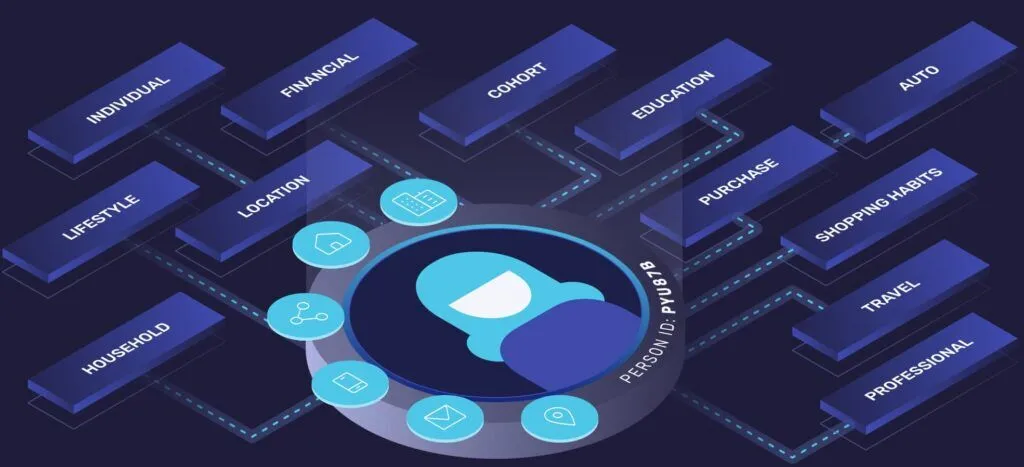
A real identity graph differs from a customer database built on personally identifiable information (PII) in one fundamental way: it connects people across identifiers without relying solely on stored PII as the anchor. A customer database treats PII like a name, email address, or phone number as the record itself, while an identity graph treats those signals as edges in a network, linking anonymous and authenticated data points to a persistent, unified representation of a real person. The sections below unpack the structural differences, where PII-based databases fall short, and how a true identity graph handles the full complexity of modern digital identity.
What makes an identity graph different from a relational database?
An identity graph is fundamentally different from a relational database because it is built around relationships between identifiers rather than rows of stored attributes. Where a relational database organizes data into structured tables with fixed schemas, an identity graph maps the connections between signals (device IDs, email hashes, cookies, IP addresses, and more) to resolve them to a single individual over time and across contexts.
In a relational database, a customer record is a static snapshot. It holds whatever fields were populated at the time of capture: a name, an email, a mailing address, a purchase history. Queries retrieve rows. Joins link tables. But the underlying assumption is that each record represents one known entity with a fixed set of attributes. When that person switches devices, uses a different email, or browses without logging in, the relational model has no native mechanism to recognize them as the same individual.
An identity graph, by contrast, is designed to handle exactly that ambiguity. It stores not just the data points themselves but the probabilistic and deterministic connections between them. The graph knows that a particular mobile advertising ID, a hashed email address, and a household IP address all resolve to the same person, even if no single session ever provided all three together. The graph is the resolution layer. The relational database is a record-keeping layer.
This architectural difference has real consequences for what each system can do:
- A relational database answers the question “What do we know about this record?”
- An identity graph answers the question “Who is this person, regardless of which identifier they showed up with today?”
- A relational database degrades in accuracy as customer data fragments across devices and channels.
- An identity graph improves in accuracy as more signals are ingested and linked over time.
The graph model also handles scale and change more gracefully. People change email addresses, replace phones, move to new households. A relational database requires manual deduplication or expensive ETL processes to reconcile those changes. An identity graph continuously updates the edges between identifiers, so the resolution stays current without rebuilding records from scratch.
Why does a PII-based customer database fall short for identity resolution?
A PII-based customer database falls short for identity resolution because it depends on a person actively providing their personally identifiable information at every touchpoint, and most digital interactions do not include that disclosure. When a user browses anonymously, switches devices, or declines to log in, a PII-anchored system has no way to recognize them, leaving the majority of digital traffic unresolved and unaddressed.
The core limitation is structural. Personally identifiable information like an email address or a phone number is a known, stable identifier. It works well as a primary key in a transactional database because it uniquely identifies a record. But identity resolution is not a transactional problem. It is a recognition problem. And recognition requires connecting signals that are often partial, pseudonymous, or entirely anonymous.
The authentication gap
Only a fraction of digital interactions are authenticated. A visitor who lands on a website from an ad, reads a product page, and leaves without logging in generates behavioral signals, but none of them contain personally identifiable information. A PII-based system cannot link that session to any known customer record. That gap means marketing attribution is incomplete, personalization is impossible for a large share of traffic, and suppression lists cannot exclude known customers who are browsing anonymously.
Data decay and fragmentation
Even when PII is captured, it decays. People change email addresses. Phone numbers are recycled. Mailing addresses become outdated. A customer database built on PII as its primary anchor becomes less accurate over time unless it is constantly refreshed. Fragmentation compounds this problem: the same person may exist in the database under multiple email addresses from different sign-up moments, creating duplicate records that a relational model cannot automatically reconcile without explicit deduplication logic.
Beyond decay, there is the regulatory dimension. Storing raw personally identifiable information at scale creates compliance obligations under privacy frameworks like GDPR and CCPA. The more PII a system accumulates, the larger its regulatory surface area. A well-designed identity graph can operate with hashed or tokenized identifiers rather than raw PII, reducing that exposure while still enabling accurate person-level resolution.
How does a real identity graph connect anonymous and authenticated signals?
A real identity graph connects anonymous and authenticated signals by maintaining a persistent node for each resolved individual and continuously linking new identifiers to that node as they appear, regardless of whether those identifiers contain personally identifiable information. When an authenticated signal like a hashed email is observed alongside an anonymous signal like a device ID, the graph creates an edge between them, anchoring the anonymous identifier to a known identity cluster.
This process works through a combination of deterministic and probabilistic matching. Deterministic matching uses exact, verified connections: a user logs in on two devices, and both device IDs are now definitively linked to the same identity node. Probabilistic matching uses statistical inference: two devices consistently appear on the same household network, exhibit similar behavioral patterns, and share overlapping browsing windows, suggesting they belong to the same person even without a confirmed login event.
The practical result is that a real identity graph can recognize a returning visitor even when they arrive anonymously. If that visitor’s device ID has previously been linked to a known email address through a prior authenticated session, the graph surfaces that connection in real time. The business can then apply personalization, suppression, or audience segmentation based on the full identity profile, not just the thin signal present in the current session.
This capability also extends offline. Authenticated signals are not limited to digital logins. A loyalty card swipe, a point-of-sale transaction, or a call center interaction all generate identifiers that a mature identity graph can incorporate. When those offline signals are linked to online identifiers, the graph builds a more complete picture of the individual across every channel they interact with, which is the foundation for genuinely omnichannel personalization and measurement.
The speed of resolution matters too. For the graph to be useful in live digital contexts (serving a personalized web experience, triggering a real-time audience segment, or informing a bidding decision in programmatic advertising), the resolution has to happen fast enough to influence the interaction before it ends. A graph that requires batch processing cannot serve those use cases. Real-time resolution at the moment of an incoming signal is what separates an operational identity graph from an analytical data asset.
How FullContact helps with identity resolution beyond PII
We built our Identity Graph specifically to address the limitations that PII-based customer databases cannot overcome on their own. Rather than treating personally identifiable information as the anchor for every record, our Resolve platform connects authenticated and anonymous identifiers to a persistent, person-level identity node, delivering resolution in real time, with API responses in under 150 milliseconds.
Here is what that means in practice for the businesses we work with:
- We match incoming identifiers (whether a hashed email, a mobile ad ID, a cookie, or an IP address) to a unified customer profile without requiring a login or PII disclosure in every session.
- We append 900+ personal and professional insights to new and existing customer records, enriching profiles far beyond what a standalone customer database can hold.
- We operate on a privacy-safe architecture that keeps your data yours: you gain access to our identity graph without surrendering your own customer data.
If you are evaluating how identity resolution can close the gaps in your current customer data strategy, we would be glad to walk you through how it works for your specific use case; feel free to contact us and start the conversation.