Poor PII data quality directly undermines personalization and customer experience by causing brands to treat real people as incomplete or mismatched records. When personally identifiable information is inaccurate, outdated, or fragmented across systems, the personalized experiences customers expect become impossible to deliver consistently. The sections below break down exactly where this breaks down and what you can do about it.
How does poor PII data quality hurt personalization?
Poor PII data quality hurts personalization by creating a distorted or incomplete picture of who a customer actually is. When personally identifiable information contains errors, duplicates, or gaps, every downstream decision built on that data inherits those flaws. The result is messaging that feels generic, irrelevant, or even off-putting to the people receiving it.
Personalization depends on connecting the right signal to the right person at the right moment. When the underlying personally identifiable information is unreliable, that connection breaks down in predictable ways. A customer who recently made a purchase might still receive a promotion for the exact product they just bought. A loyal customer might be treated as a new visitor because their email address from one channel does not match the phone number captured in another. These are not minor inconveniences. They erode trust and signal to customers that the brand does not really know them.
There are several ways degraded PII data quality shows up in personalization failures:
- Duplicate profiles: The same person exists as multiple records, leading to repeated or contradictory messaging.
- Stale data: Contact details, location, or lifecycle stage information that no longer reflects reality causes mismatched offers.
- Incomplete records: Missing identifiers mean segments cannot be built accurately and relevant touchpoints are missed entirely.
- Cross-channel disconnects: A customer recognized on one channel is treated as a stranger on another because identifiers are not linked.
Beyond the customer experience impact, poor personally identifiable information quality creates real operational costs. Marketing spend is wasted reaching the wrong people or suppressing the wrong records. Analytics become unreliable because the data feeding them does not reflect actual customer behavior. Over time, these compounding inaccuracies make it harder to course-correct because the problem is embedded throughout the data layer.
What types of PII data matter most for customer experience?
The personally identifiable information that matters most for customer experience is the data that reliably identifies a person across contexts and channels. This includes core contact identifiers like email addresses and phone numbers, behavioral and transactional signals tied to those identifiers, and device-level data that connects online interactions back to a known individual.
Not all personally identifiable information carries equal weight when it comes to building meaningful customer experiences. Some identifiers are foundational because they are stable, widely used, and easy to match across systems. Others are valuable because they add context that enables relevance.
Core identifiers that anchor customer records
Email addresses and phone numbers are the most reliable anchors for a customer record because they are persistent, voluntarily shared, and consistently used across both digital and offline interactions. When a customer provides an email at checkout, signs up for a newsletter, or authenticates in an app, that email becomes the thread that can tie their entire history together. Phone numbers serve a similar function, particularly as mobile becomes the dominant channel for authentication and communication.
Name and physical address data remain important, especially for brands that operate in direct mail, logistics, or regulated industries. These identifiers help validate that digital signals belong to the right real-world person and are essential for compliance with privacy regulations that require accurate records of who data belongs to.
Behavioral and contextual signals that add depth
Beyond the core identifiers, behavioral data tied to personally identifiable information dramatically improves the quality of customer experience. Purchase history, browsing patterns, support interactions, and engagement with previous campaigns all add context that makes personalization feel genuinely relevant rather than formulaic. When this behavioral data is accurately linked to the right individual, brands can anticipate needs rather than simply react to them.
Device identifiers, IP signals, and cookie data serve as connective tissue between anonymous interactions and known profiles. Their value depends entirely on how well they can be resolved back to a verified individual. Without that resolution, they remain useful for aggregate analytics but fall short for true one-to-one personalization.
How does identity resolution improve PII data quality?
Identity resolution improves PII data quality by connecting fragmented identifiers from different sources and channels into a single, accurate, and unified customer profile. Rather than treating each data point in isolation, identity resolution maps relationships between identifiers so that a person is recognized as the same individual regardless of where or how they interact with a brand.
The core problem with personally identifiable information quality is not always that the data is wrong in isolation. It is that the same person appears differently across systems. An email captured at signup, a phone number provided at point of sale, and a device ID from a mobile app may all belong to the same individual, but without a mechanism to link them, they exist as separate, incomplete records. Identity resolution solves this by building and continuously updating a network of connections between identifiers.
This matters for PII quality in several concrete ways. First, it eliminates duplicate records by confirming that two profiles belong to the same person, allowing them to be merged rather than maintained separately. Second, it fills gaps in individual records by drawing on linked identifiers that carry information not captured in the primary record. A profile missing a mailing address might be enriched because that address is associated with a matched phone number in the identity graph. Third, it keeps records current by detecting when an identifier changes and updating the linked profile accordingly rather than waiting for a customer to self-report a change.
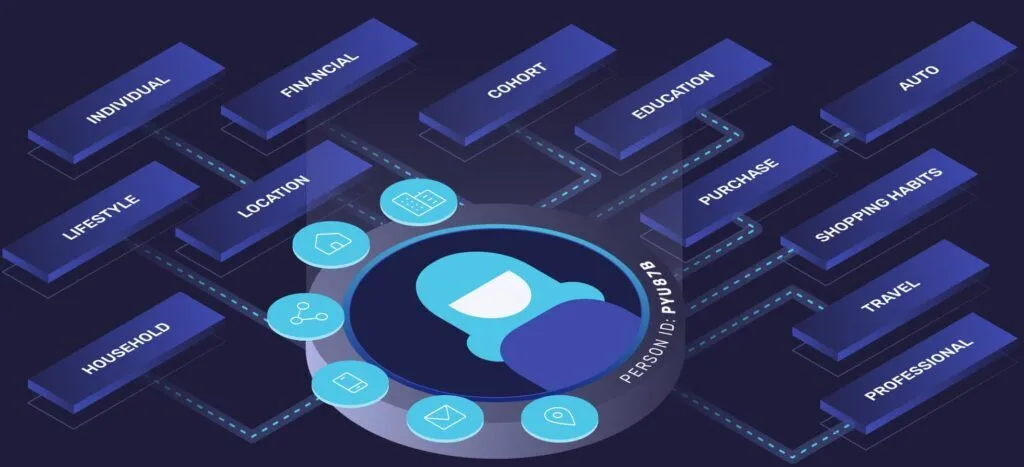
The Identity Graph is the infrastructure that makes this possible at scale. An identity graph stores not just individual data points but the probabilistic and deterministic relationships between them, allowing a platform to reason about which signals belong to the same real person with high confidence. This is fundamentally different from a traditional customer database, which stores records but cannot reason about the connections between them.
For brands, the practical outcome is that personally identifiable information becomes more complete, more accurate, and more actionable over time. Personalization built on identity-resolved data can reach the right person consistently, whether they are interacting through a mobile app, a website, a call center, or a physical location. The customer experience improves because the brand is working from a single coherent view of who that person is rather than a patchwork of partial records.
How FullContact helps improve PII data quality and personalization
We built our platform specifically to solve the PII data quality challenges that make personalization fall short. Our real-time identity resolution technology links authenticated and anonymous identifiers across channels into unified customer profiles, so the data your teams work with reflects real people rather than fragmented signals. Here is what that looks like in practice:
- Real-time resolution: We match incoming identifiers against our identity graph and return a unified profile in under 150 milliseconds, so personalization decisions happen at the speed of the customer interaction.
- Data enrichment: We append 900+ personal and professional insights to new and existing records, filling the gaps that leave profiles incomplete and personalization generic.
- Privacy-safe architecture: Our approach keeps your data secure while still enabling the identity linkage needed to improve data quality across your systems.
If improving the quality of your personally identifiable information and delivering more consistent, relevant customer experiences is a priority for your team in 2026, we would love to show you how we can help. Contact us to start the conversation.