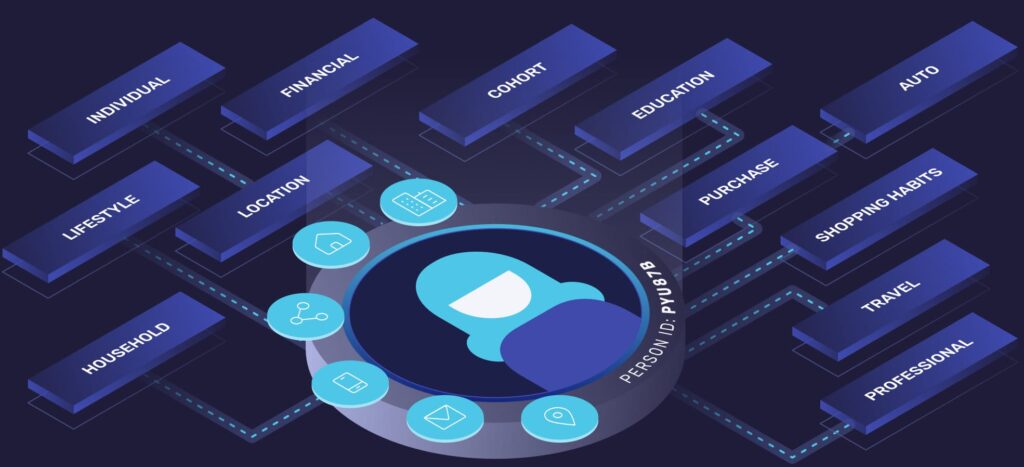
Personally identifiable information, or PII, is the foundational connective tissue that makes a unified customer profile possible. When a business collects identifiers like an email address, phone number, or device ID, PII is what allows those scattered data points to be linked back to a single, real individual. Without it, customer data remains fragmented across channels, devices, and touchpoints, making meaningful personalization nearly impossible.
For marketers and enterprises in 2026, the ability to responsibly collect, manage, and activate personally identifiable information is what separates a truly unified customer view from a collection of disconnected records. The sections below break down how PII connects fragmented data, which types matter most for identity resolution, and how to handle it in a way that builds customer trust rather than eroding it.
How does PII connect fragmented customer data into one profile?
PII connects fragmented customer data by serving as a common reference point that links interactions happening across different devices, channels, and sessions back to the same individual. When a customer browses on a mobile device, makes a purchase on a desktop, and signs up for an email newsletter, PII shared across those touchpoints, such as an email address or phone number, acts as the bridge that ties all of those events to one person.
The core challenge in building a unified customer profile is that modern customer journeys are inherently non-linear. A single person might interact with a brand through a dozen different touchpoints before converting, and each of those touchpoints generates its own data record. Without a shared identifier, those records look like twelve different people rather than one.
Authenticated vs. anonymous identifiers
PII can be either authenticated or anonymous in nature. Authenticated PII, like a confirmed email address or a verified phone number, is explicitly provided by the customer during a transaction or sign-up. It carries high confidence because the individual has deliberately shared it. Anonymous identifiers, such as cookie IDs or device fingerprints, are collected passively and require more sophisticated matching logic to connect to a real person.
The most robust customer profiles are built by combining both types. Authenticated PII anchors the record with certainty, while anonymous identifiers extend the profile’s reach across sessions and devices where the customer has not explicitly logged in.
The matching process
Identity resolution platforms use PII as the input for a matching process that compares incoming identifiers against a broader identity graph. When a new data point arrives, the system checks whether that email address, phone number, or device ID already exists in a known record. If it does, the new interaction is appended to the existing profile rather than creating a duplicate. Over time, this process builds a progressively richer and more accurate single customer record.
The quality of the match depends heavily on the quality and breadth of the identity graph being used. A graph built on years of real-world data connections, spanning both online and offline identifiers, produces far more accurate matches than one built on a narrow set of digital signals alone. You can learn more about how this works by exploring the Identity Graph and the role it plays in connecting data at scale.
What types of PII are most valuable for identity resolution?
The most valuable types of PII for identity resolution are those that are persistent, widely shared across platforms, and closely tied to a real individual. Email addresses, phone numbers, and physical mailing addresses consistently rank as the highest-confidence identifiers because they are deliberately provided by the customer, relatively stable over time, and used across a wide range of digital and offline contexts.
Not all personally identifiable information carries equal weight in an identity resolution workflow. Some identifiers are strong anchors, while others are better used as supporting signals that improve match confidence when combined with a primary identifier.
- Email address: The single most powerful identifier in digital identity resolution. It is used for account creation, communication, and authentication across virtually every online platform, making it an exceptionally reliable link between records.
- Phone number: Particularly valuable in mobile-first environments. Phone numbers are tied to carrier records and are increasingly used for two-factor authentication, which means they are frequently verified and current.
- Physical address: Bridges the gap between online and offline data. A mailing address connects digital profiles to household-level data, which is especially useful for direct mail campaigns and fraud prevention.
- Name combined with other identifiers: A name alone is not a reliable identifier due to common duplicates, but when combined with an email address or postal code it significantly improves match accuracy.
Beyond these primary identifiers, device-level signals like IP addresses, mobile advertising IDs, and cookie values contribute to identity resolution in authenticated and unauthenticated environments. These are less persistent than direct PII but remain useful for extending profile reach across sessions where a customer has not logged in.
The practical implication for businesses is that the more high-quality PII they can collect through legitimate, consensual means, the more complete and accurate their customer profiles will be. A profile anchored by a verified email address and a confirmed phone number is far more actionable than one built entirely on anonymous device signals.
How can businesses use PII responsibly while building customer profiles?
Businesses can use PII responsibly by grounding every data collection and processing decision in three principles: transparency, consent, and proportionality. Customers should know what data is being collected, why it is being collected, and how it will be used. Consent should be freely given and easily revocable. And the data collected should be limited to what is genuinely necessary for the intended purpose.
Responsible PII management is not just a legal obligation under regulations like GDPR and CCPA. It is also a commercial imperative. Customers who trust that their data is handled with care are more likely to share accurate information, engage with personalized experiences, and maintain long-term relationships with a brand. Mishandling personally identifiable information, even unintentionally, can permanently damage that trust.
Building a consent-first data collection strategy
A consent-first approach means that PII is only collected when a customer has actively agreed to share it, and only for the purposes they have been clearly informed about. This goes beyond a pre-ticked checkbox. It means presenting data collection choices in plain language, giving customers genuine options, and honoring those choices consistently across every channel and system.
Practically, this involves maintaining a preference center where customers can update their data sharing choices at any time, and ensuring that those preferences are propagated across all downstream systems and data partners in real time. A consent record that exists in one system but is not respected in another creates both a compliance risk and a trust problem.
Data minimization and purpose limitation
Responsible PII use also requires discipline about what data is actually collected and retained. The principle of data minimization holds that businesses should only collect personally identifiable information that is directly relevant to a stated business purpose. Collecting additional data “just in case it becomes useful later” increases risk without a corresponding benefit.
Purpose limitation is closely related. PII collected for one purpose, such as processing a transaction, should not be repurposed for a different use, such as behavioral profiling, without explicit customer consent for that new use. Maintaining clear internal records of what data was collected, when, under what consent basis, and for what purpose is essential for demonstrating compliance and maintaining customer trust.
How FullContact helps businesses build unified profiles with PII
We built our Resolve platform specifically to help businesses turn fragmented personally identifiable information into accurate, unified customer profiles, without compromising on privacy or compliance. Our approach connects authenticated and anonymous identifiers in real time, matching incoming data against a true identity graph built over more than a decade of online and offline data relationships. Here is what that means in practice:
- Real-time identity resolution: We return API responses in under 150 milliseconds, so customer profiles are enriched and matched at the moment of interaction, not hours later.
- 900+ enrichment attributes: Beyond matching, we append personal and professional insights to customer records, giving businesses a richer picture of who their customers are.
- Privacy-safe architecture: Our platform is designed so that your data stays yours. You gain access to the depth of our identity graph without sharing your customer data with third parties.
- Cross-device and cross-channel matching: We connect identifiers across devices and channels, whether authenticated or anonymous, to build a single customer view that follows the individual, not the device.
If you are ready to move beyond fragmented records and start building customer profiles that actually reflect real people, we would love to help. Contact us to talk through how identity resolution can work for your specific use case.
Related Articles
- What is the difference between PII management and data governance?
- What is PII management and why does it matter?
- How do identity graphs connect customer data across devices?
- How do identity graph providers resolve anonymous and authenticated identifiers?
- What are the key benefits of using an identity graph?