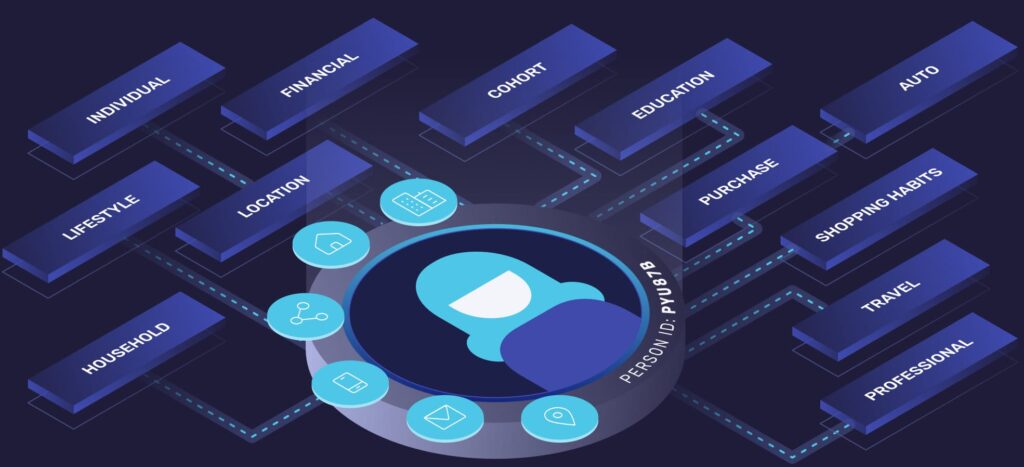
An identity graph plays a central role in audience segmentation by connecting fragmented data points (device IDs, email addresses, behavioral signals, and offline records) into unified, persistent profiles of real individuals. Instead of segmenting based on incomplete or duplicated data, marketers can build segments grounded in a full, accurate picture of each person. The sections below explore how that works in practice, what segment types become possible, and how real-time resolution changes live campaign performance.
How does an identity graph improve audience segmentation accuracy?
An identity graph improves audience segmentation accuracy by resolving multiple identifiers (cookies, device IDs, email addresses, phone numbers, and offline data) into a single, deduplicated profile for each real person. This eliminates the fragmentation that causes the same individual to appear as multiple separate records, so every segment reflects actual people rather than data artifacts.
Traditional segmentation relies on isolated data sources. A brand might have a customer’s email from a loyalty program, a device ID from a mobile app visit, and a browser cookie from a web session, but without a way to link these together, each one looks like a different person. The result is segments that are riddled with duplicates, gaps, and misattributions. A user counted in a “high-value customer” segment on one channel might simultaneously appear in a “new visitor” segment on another.
Identity graphs solve this by acting as the connective tissue between all those identifiers. When a new signal arrives (say, an anonymous website visit), the graph cross-references it against known associations and links it back to an existing profile. The segment that person belongs to updates accordingly, without manual intervention.
The accuracy gains affect segmentation in several concrete ways:
- Audience sizes reflect true reach rather than inflated counts caused by duplicate records
- Behavioral signals from different channels are attributed to the correct individual, making behavioral segments more reliable
- Suppression lists become more effective because known customers are recognized across all their identifiers, not just the one used at the point of contact
- Lookalike modeling improves because the seed audience is built from clean, complete profiles rather than noisy, fragmented data
The depth of the identity graph also matters. A graph that incorporates both online and offline data (purchase history, in-store visits, call center interactions) produces profiles with far more signal than one limited to digital touchpoints. That richness translates directly into more precise and meaningful audience segments, because the attributes available for segmentation logic are more complete and more accurate.
What types of audience segments can an identity graph unlock?
An identity graph unlocks audience segments that are impossible to build from single-source or channel-specific data alone. Because the graph unifies online behavior, offline activity, professional attributes, and demographic signals into one profile, marketers can define segments based on the full scope of who a person is and what they have done across every touchpoint.
Behavioral and lifecycle segments
With cross-channel behavioral data unified at the person level, brands can build segments that reflect the entire customer journey rather than a slice of it. A “lapsed customer” segment, for example, becomes far more precise when it accounts for in-store purchases, not just online transactions. Similarly, lifecycle segments like “recently onboarded” or “at risk of churn” can incorporate signals from multiple channels that, taken together, paint a clearer picture of where someone is in their relationship with the brand.
Behavioral segments also become more actionable when they are person-level rather than device-level. A user who browsed a product on mobile, read a review on desktop, and purchased in-store represents a single conversion journey. An identity graph captures that as one continuous sequence, making it possible to segment by journey patterns that would otherwise be invisible.
Attribute-based and professional segments
Beyond behavior, identity graphs that incorporate professional and demographic data allow for segments based on who someone is, not just what they have done. Industries, job functions, company size, household composition, and life stage signals all become available as segmentation criteria when the identity graph is built on a rich, multi-source data foundation.
This is particularly valuable for B2B marketers who need to reach decision-makers within specific industries, or for consumer brands that want to align messaging with life stage (new homeowners, recent graduates, growing families). These segments require data that no single channel collects on its own, but an identity graph can surface them by connecting the right signals across sources.
How does real-time identity resolution affect segmentation in live campaigns?
Real-time identity resolution allows audience segments to update dynamically as new signals arrive, meaning a live campaign can respond to a person’s most recent behavior rather than a static snapshot taken days or weeks earlier. When identity resolution happens in milliseconds, the segment a person belongs to at the moment of an ad impression or website visit reflects their current status, not an outdated one.
The practical impact on live campaigns is significant. Without real-time resolution, segments are typically built in batch processes: data is collected, processed overnight or weekly, and segments are refreshed with a lag. During that window, a customer might convert, opt out, or shift from one lifecycle stage to another, but the campaign keeps treating them as they were when the segment was last built. This causes wasted spend, poor experiences, and missed opportunities.
Real-time identity resolution closes that gap in several ways. When an anonymous visitor arrives on a website, the identity graph can resolve their device or browser signal to a known profile within a fraction of a second. If that profile belongs to a current customer, they can be excluded from acquisition campaigns immediately. If they qualify for a different segment based on their profile attributes, they can be served the appropriate message without any manual segment refresh.
For retargeting and personalization use cases, the speed of resolution directly affects relevance. A person who abandoned a cart an hour ago is far more likely to respond to a retargeting message than someone who did so three weeks ago. Real-time identity resolution makes it possible to act on fresh signals before they lose their predictive value, keeping segment membership aligned with where each person actually is in their decision process.
Real-time resolution also supports suppression and compliance at campaign speed. If a person opts out of communications, that signal can propagate across all active campaigns immediately rather than waiting for the next batch update. This protects both the customer experience and the brand’s compliance posture in regulated environments.
How FullContact helps with identity graph-driven audience segmentation
We built our Resolve platform specifically to address the challenges that make accurate audience segmentation difficult at scale. Our identity graph connects online and offline identifiers into persistent, person-level profiles, giving marketers the foundation they need to build segments that reflect real individuals rather than fragmented data. Here is what that looks like in practice:
- Real-time API responses in under 150 milliseconds, so identity resolution keeps pace with live campaign decisions
- The ability to append 900+ personal and professional attributes to customer profiles, unlocking behavioral, demographic, and professional segmentation criteria in one place
- Privacy-safe resolution that works across authenticated and anonymous identifiers without exposing your underlying customer data
- A true identity graph built over a decade of data, connecting online and offline signals around real individuals rather than devices or sessions
Whether you are trying to reduce audience duplication, build richer lifecycle segments, or make your live campaigns more responsive to real-time behavior, we would be glad to show you how our platform fits your specific use case. Feel free to contact us to start the conversation.